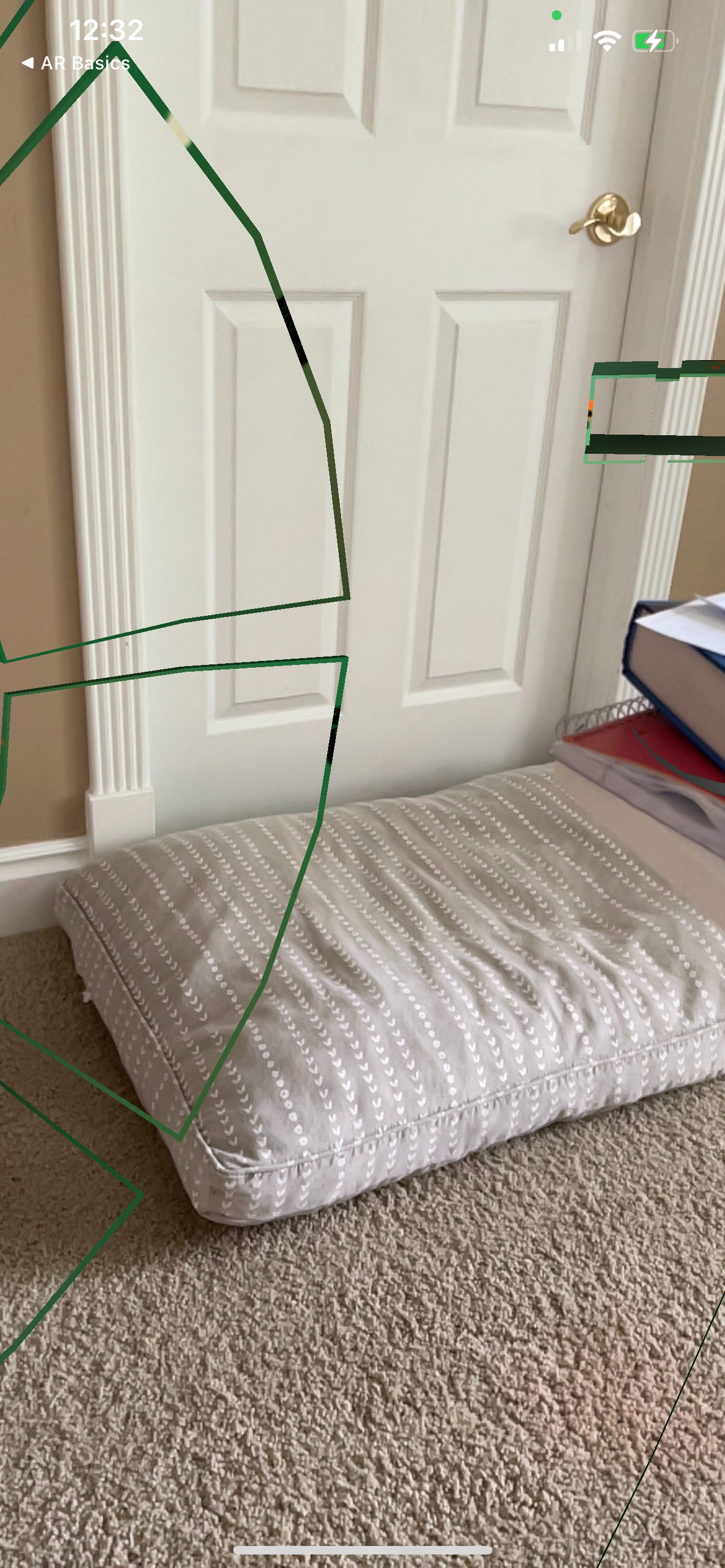
Thank you for the response. So I took out that code here
func session(_ session: ARSession, didAdd anchors: [ARAnchor]) {
    print(anchors)
  }
and when it detects this dog bed as a plane it renders my model but I'm inside R2. hahah. So on the apple example for arkit onTap I did the appropriate translations and scales as my model was a lot bigger than the little cube that gets rendered on the example code. So I was trying to do the same with the plane anchor in the above function. However, it seems it is not rendering it on the plane quite right.
 @objc
  func handleTap(gestureRecognize: UITapGestureRecognizer) {
    // Create anchor using the camera's current position
    if let currentFrame = session.currentFrame {

      // Create a transform with a translation of 0.2 meters in front of the camera
      var translation = matrix_identity_float4x4
      var scale = matrix_identity_float4x4
      translation.columns.3.z = -2

      scale.columns.0.x = 0.1
      scale.columns.1.y = 0.1
      scale.columns.2.z = 0.1

      let rotationY = float4x4().rotateYAxis(by: 180)
      let rotationZ = float4x4().rotateZAxis(by: 270)
      let rotation = rotationY * rotationZ
      let tranformation = translation * scale * rotation
      let transform = simd_mul(currentFrame.camera.transform, tranformation)

      // Add a new anchor to the session
      let anchor = ARAnchor(transform: transform)
      session.add(anchor: anchor)
    }
  }
I also noticed in the template code that there is the part that updates the anchors and it updates the coordinate transform. Do I need to maybe apply translation and scale here?
func updateAnchors(frame: ARFrame) {
    // Update the anchor uniform buffer with transforms of the current frame's anchors
    anchorInstanceCount = min(frame.anchors.count, kMaxAnchorInstanceCount)

    var anchorOffset: Int = 0
    if anchorInstanceCount == kMaxAnchorInstanceCount {
      anchorOffset = max(frame.anchors.count - kMaxAnchorInstanceCount, 0)
    }

    for index in 0..<anchorInstanceCount {
      let anchor = frame.anchors[index + anchorOffset]

      // Flip Z axis to convert geometry from right handed to left handed
      var coordinateSpaceTransform = matrix_identity_float4x4
      coordinateSpaceTransform.columns.2.z = -1.0

      let modelMatrix = simd_mul(anchor.transform, coordinateSpaceTransform)
      let anchorUniforms = anchorUniformBufferAddress.assumingMemoryBound(to: InstanceUniforms.self).advanced(by: index)
      anchorUniforms.pointee.modelMatrix = modelMatrix
    }
  }
Here is what it looks like when it detects the dog bed plane and then renders R2.