

-
Explore a computação numérica em Swift com o MLX
Integre a computação baseada no NumPy de forma nativa no Swift com o MLX Swift. Descubra como eliminar o atrito entre linguagens nos fluxos de trabalho de aprendizado de máquina ao lidar com processamento de imagens, operações de tensores e treinamento de redes neurais em um único ambiente seguro para tipos. Explore as APIs que permitem aproveitar a aceleração por GPU sem abrir mão da experiência de compilação, das ferramentas e da depuração que você já conhece.
Capítulos
- 0:00 - Introdução
- 0:57 - MLX Swift e o ecossistema da Apple
- 3:04 - MLX Swift
- 4:28 - Mandelbrot
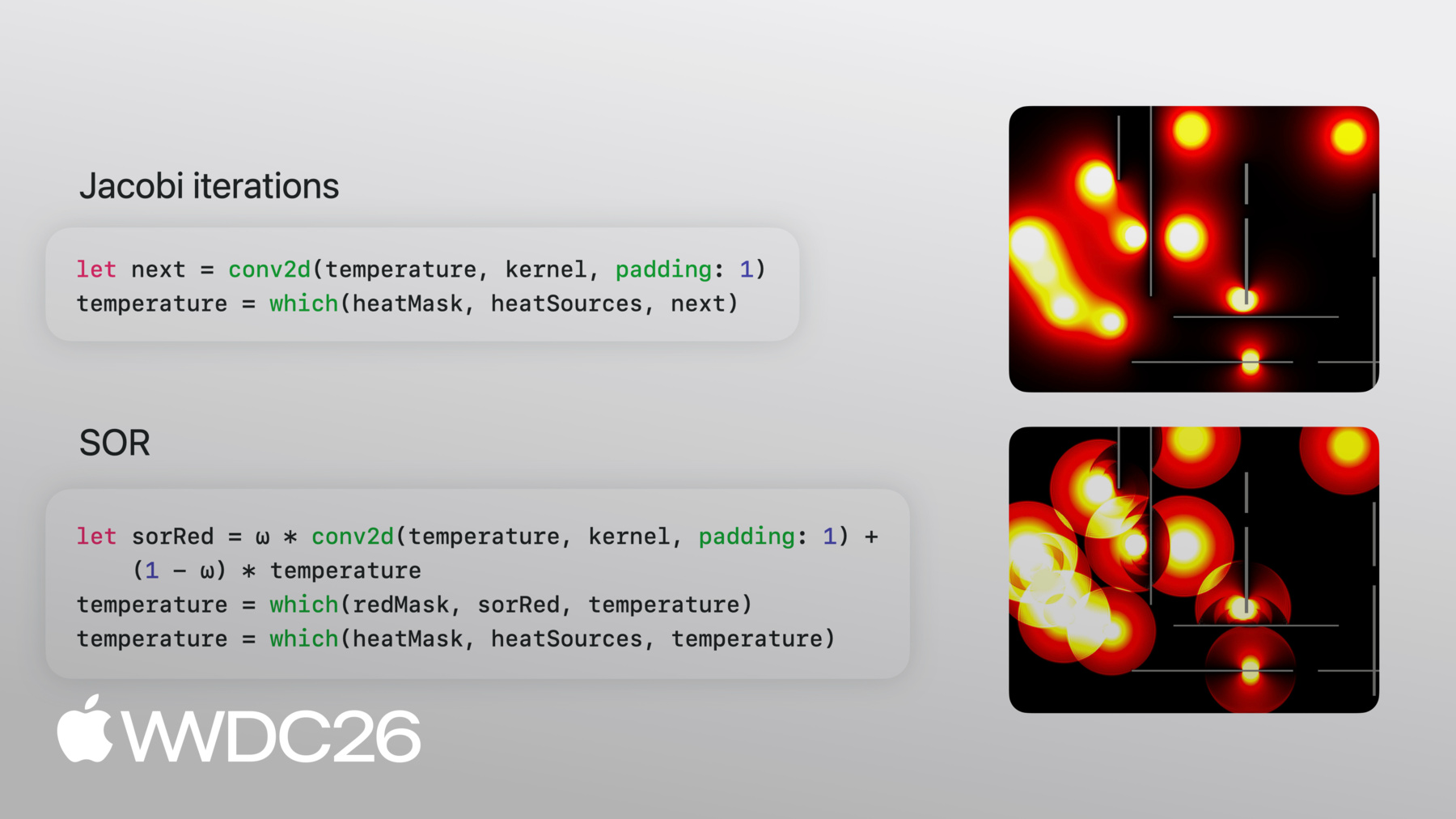
- 6:34 - Distribuição de calor
- 8:12 - Convergência mais rápida com SOR
- 10:17 - Ajuste de curvas
- 12:17 - O conjunto completo de ferramentas e o ecossistema MLX
- 13:47 - Próximas etapas
Recursos
- MLX Swift LM on GitHub
- MLX Swift Examples
- MLX Examples
- MLX Swift
- MLX LM - Python API
- MLX Explore - Python API
- MLX Framework
- MLX
Vídeos relacionados
WWDC26
- Execute IA agêntica localmente no Mac usando o MLX
- Explore inferência e treinamento distribuído com o MLX
WWDC25
-
Buscar neste vídeo...
-
-
3:04 - Power iteration with MLX Swift arrays
import MLX let n = 100 let steps = 10 let B = MLXRandom.normal([n, n]) var v = MLXRandom.normal([n]) // get symmetric matrix A = Bᵀ + B let A = B.T + B // Power iteration → top eigenvector of A. // v ← A v / ‖A v‖ for _ in 0 ..< steps { let Av = matmul(A, v) v = Av / norm(Av) eval(v) } // recover the eigenvalue. // λ = vᵀ A v let lambda = matmul(matmul(v.T, A), v) print(lambda) -
5:09 - Mandelbrot set in plain Swift (scalar)
// Plain Swift, scalar-at-a-time var counts = Array2D<Int>(width: w, height: h) for y in 0 ..< h { for x in 0 ..< w { let c = Complex(xMin + Float(x) * xStep, yMin + Float(y) * yStep) var z = Complex<Float>.zero var limit = maxIterations for i in 0 ..< maxIterations { z = z * z + c if z.lengthSquared > radiusSquared { limit = i break } } counts[x, y] = limit } } -
5:27 - Mandelbrot set in MLX Swift (array)
// Compute the Mandelbrot set on a grid of complex numbers import MLX let x = linspace(Float(-2.0), 0.5, count: w) let y = linspace(Float(-1.25), 1.25, count: h).reshaped(h, 1) let c = x + y.asImaginary() var z = MLXArray.zeros(like: c) var counts = MLXArray.zeros(c.shape, dtype: .int16) for _ in 0 ..< maxIterations { z = z * z + c // iterate z ← z² + c counts = counts + (abs(z) .< 2) // count bounded iterations } -
7:27 - Jacobi iteration with conv2d
// Jacobi iteration: average the four neighbors // Convolution weights let kernel = MLXArray(converting: [ 0, 0.25, 0, 0.25, 0, 0.25, 0, 0.25, 0, ]).reshaped(1, 3, 3, 1) // Initial value var temperature = heatSources // Run this in a loop until convergence let next = conv2d(temperature, kernel, padding: 1) temperature = which(heatMask, heatSources, next) -
9:17 - Successive Over-Relaxation (SOR)
// Successive Over-Relaxation: blend the previous and next state let ω: Float = 2.0 / (1.0 + sin(Float.pi / Float(max(M, N)))) let redMask = checkerboard(rows: M, cols: N, phase: 0) let blackMask = checkerboard(rows: M, cols: N, phase: 1) // Update red cells using black neighbors let sorRed = ω * conv2d(temperature, kernel, padding: 1) + (1 - ω) * temperature temperature = which(redMask, sorRed, temperature) temperature = which(heatMask, heatSources, temperature) // Update black cells using (now-updated) red neighbors let sorBlack = ω * conv2d(temperature, kernel, padding: 1) + (1 - ω) * temperature temperature = which(blackMask, sorBlack, temperature) temperature = which(heatMask, heatSources, temperature) -
11:13 - Curve fitting with automatic differentiation
// Define a loss, then optimize it with autodiff
// x, y: data points as MLXArrays
func f(_ θ: MLXArray) -> MLXArray {
    θ[0] + θ[1] * x + θ[2] * x ** 2
}

func loss(_ θ: MLXArray) -> MLXArray {
    mean((f(θ) - y) ** 2)
}

var θ = zeros([numParams])
let gradLoss = grad(loss)

for _ in 0 ..< steps {
    let g = gradLoss(θ)         // ∇L(θ)
    θ = θ - learningRate * g    // parameter update
    eval(θ)                     // force evaluation
}
-