Distinguished Winners

We’ll name Distinguished Winners whose work is truly exceptional and invite them to join us at Apple in Cupertino, where they’ll gain invaluable insights from Apple experts and engineers, connect with their peers, and enjoy a host of unforgettable experiences. Travel and lodging included.

Learn more about the Distinguished Winner experience

Anton Baranov (Germany)
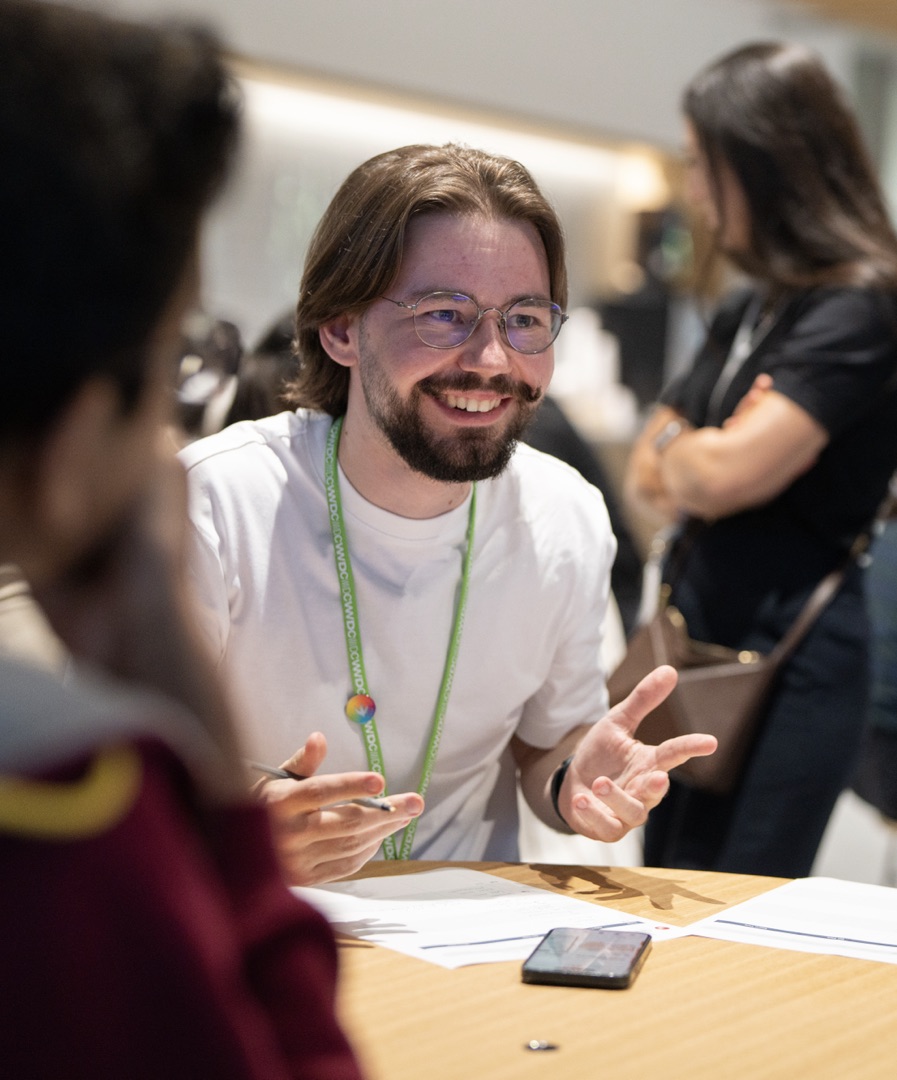
Distinguished Winner Anton Baranov from Germany talking with fellow attendees at WWDC, creator of the Pitch Coach presentation app

For Anton Baranov, life is one big pitch meeting.

“As a child, I pitched getting a dog to my parents. Someday, I will pitch marriage. Everything is a pitch. And all those pitches can be reviewed and improved,” he says.

To make that possible, the 22-year-old developer from Frankfurt, Germany, created the app Pitch Coach to help people prepare for moments that require boldness, vulnerability, and a bit of rehearsal. Released in March 2026, Pitch Coach is designed to provide immediate feedback and ideas for improvement. The app offers AI-powered translation, bringing real-time feedback in 92 languages.

“When you’re speaking, it’s hard to notice your own habits. You start rushing or lose the point without realizing it,” Baranov says.

The app can point out mistakes and remark on whether words were delivered too fast or too slow. “Feedback only matters if it changes what happens next. Pitch Coach uses what tripped you up to shape what you practice,” he says. A core feature is the clever use of AirPods, both to analyze posture and to listen for filler words. People can also turn on the camera for even more feedback on body language. “Then it gives an overview score — how it went, what you can improve,” Baranov says.

Baranov says he had an “unforgettable” moment when he pitched his own app in front of Tim Cook and John Ternus at WWDC26.

Some Pitch Coach fans are public speakers; one wrote in to say the app helped him find confidence ahead of a job interview. “That’s exactly why the app exists,” Baranov says. “To help you make sure your idea will be heard.”
Rino Ito (Japan)

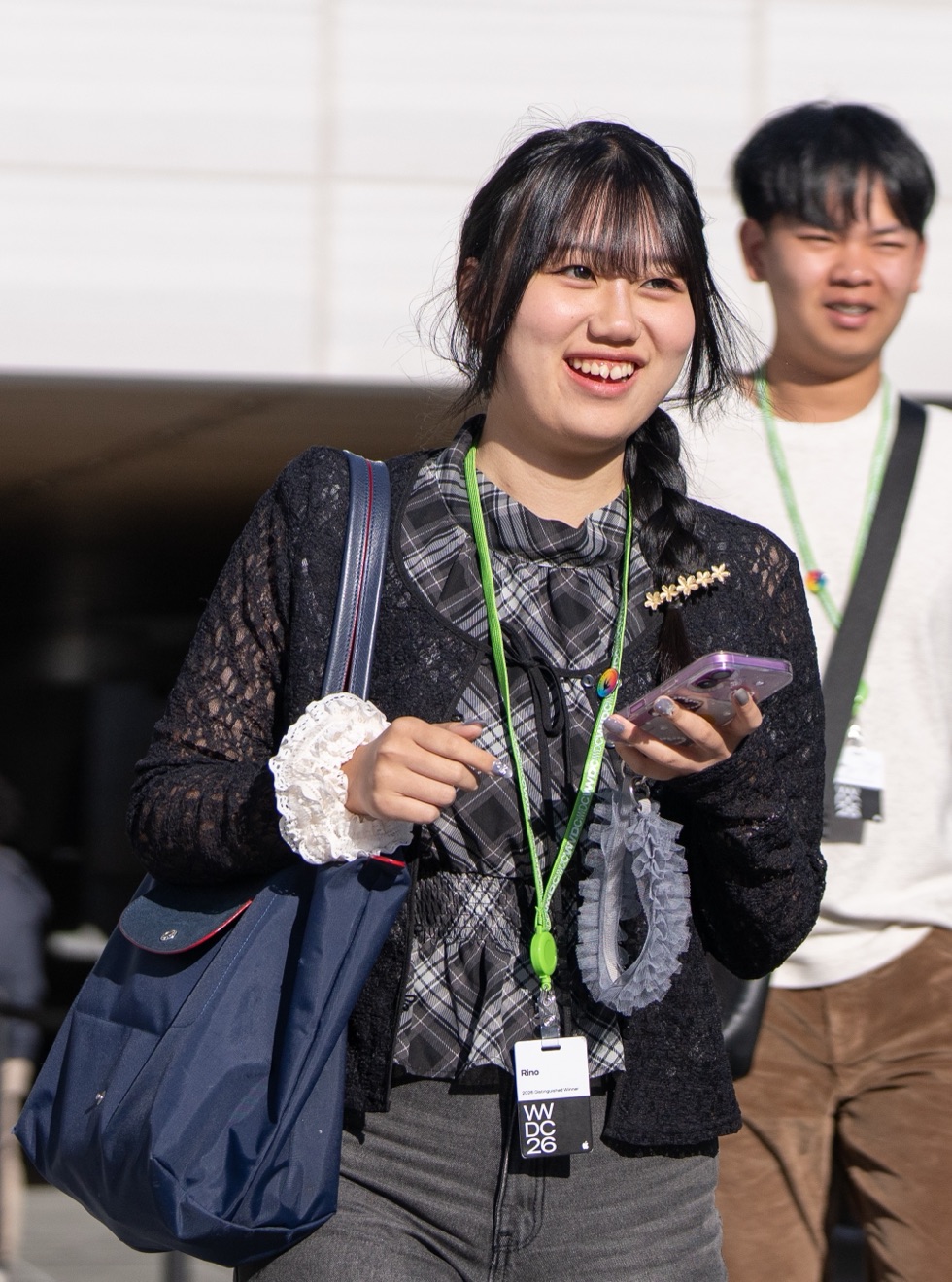
Distinguished Winner Rino Ito from Japan walking with fellow attendees at WWDC26

The first time Rino Ito reached for a Daruma, she was a high school senior daunted by her university entrance exams.

Hoping to bolster her spirits, she wandered the market where the hand-painted dolls are sold and chose a red one. On its back, she wrote a pledge to get into her first-choice university. Then she finished the step that makes the Daruma special: She colored in one eye and waited for her goal to be met. Only then could she paint in the other.

“To me, a Daruma is a reminder of my commitment and a source of support as I take on challenges,” Ito says.

Not everyone can buy their own Daruma from Japan’s famous Takasaki Daruma Market. But thanks to Ito’s ColortheGoalDaruma app, the experience is available with just a few swipes.

Just as Daruma dolls are traditionally hand-drawn, Ito began by sketching her ideas on paper, then built her app in Swift. She used AI to help with coding, but the visuals are entirely her own, a “balance between playfulness and clarity.”

In the app, people are greeted by one of the jolly-faced dolls and prompted to pick a color, each corresponding to a different goal. Through a chat-based conversation, they refine their wishes. Ito designed each step to build a personal connection to the goal and a stronger commitment to reaching it.

Ito uses ColortheGoalDaruma to further her dancing hobby. Before, without a clear metric like a score, she says she struggled to know what to work toward. The app reframed that for her. “It helped me recognize the things I personally want to do as goals worth pursuing,” she says.

Now a Swift Student Challenge winner, Ito has come a long way since those exams. Today she runs the Swift Students Community Japan and studies cognitive science, sociology, and engineering.

“The experience made me realize that when I lack confidence, I sometimes place limits on my own dreams. Winning showed me how important it is to take a chance and try, even when you don’t know what the outcome will be,” she says.

As she moves forward in her career, she remembers the words someone told her on that trip to buy her first Daruma: “There are as many wishes as there are people.”

Gaurav Kukreja (India)

Distinguished Winner Gaurav Kukreja from India at Apple Park during WWDC, showcasing his Fast Aid emergency response app

Growing up as a self-described “Apple fanboy,” Distinguished Winner Gaurav Kukreja had long dreamed of taking part in the Swift Student Challenge. There was only one problem: “I didn’t know one word of code,” the 20-year-old says.

It wasn’t until Kukreja attended the Indian Institute of Technology Kanpur that he learned Swift and Xcode. He used those new skills to build Fast Aid, an app that provides step-by-step instructions for dealing with medical emergencies such as bleeding, burns, and choking.

The idea for Fast Aid came to Kukreja after he witnessed a man experiencing a seizure on campus. Kukreja says that often in such scenarios, “no one knows what to do. There are resources, but they’re not at your fingertips.”

As a result, he made sure Fast Aid included not only easily accessible health articles and instructions, but also a Panic Mode option, in which a narrator describes how to administer CPR. “Someone who’s doing that in the moment wouldn’t have their hands free,” Kukreja explains, “so Fast Aid will keep going on to the next step — and keep asking you questions — without you having to touch your phone.”

Kukreja managed to create Fast Aid in just 15 days. “I did it in true collegiate style, with a lot of late nights,” he says. “And I’ll be honest: I did miss a few classes.” All that work paid off when he was recognized as a Swift Student Challenge 2025 Distinguished Winner and visited Cupertino during WWDC25. “I was like, ‘How did I even end up here?’” Kukreja laughs. “But the energy was incredible. It was really motivating. Once you come home, you just want to start building something.”

Larissa Okabayashi (Brazil)

Distinguished Winner Larissa Okabayashi from Brazil, creator of Yume’s Spellbook educational AI app

Swift Student Challenge 2025 Distinguished Winner Larissa Okabayashi knows that one of the first steps toward embracing artificial intelligence (AI) is understanding it. “Brazil is one of the countries where people most use AI in their daily lives,” says the São Paulo native. “But people don’t always learn the potential issues and limitations with chatbots and artificial intelligence.”

To help others learn how large language models (LLMs) work, Okabayashi created Yume’s Spellbook, an app aimed at nonexperts who are curious to know more about LLMs. With its calm and colorful design (inspired by Japanese anime), the app encourages users to help a kind and curious wizard named Yume as she casts a powerful spell that requires her to gather LLM parameters and data. Yume’s Spellbook also encourages players to “cast wisely,” gently reminding them to be aware of response quality.

“By teaching how these tools are built, I felt I could raise awareness and help people think more critically about machine learning,” notes Okabayashi, who’s currently an academic exchange student at Hamburg University of Applied Sciences in Germany.

Yume’s Spellbook isn’t Okabayashi’s first creation to find its way to the Swift Student Challenge: Her 2024 app Yume the Wizard, which included the same sprite-like character and focused on data collection, earned a win as well.

As a 2025 Distinguished Winner, Okabayashi visited Cupertino and presented her work alongside fellow developers from around the globe. “I don’t think there’s anything equal in the tech world,” Okabayashi says. “The experience makes us feel like we are the luckiest students in the world. Every time I go, I feel inspired about the future.”

AJ Nettles (USA)

Distinguished Winner AJ Nettles from USA high-fives an attendee during WWDC at Apple Park, creator of CryptOh security app

Distinguished Winner AJ Nettles says his summer trip to Cupertino during WWDC24 was an exhilarating three days of activity and community. “You know when you come back from an amusement park, and you’re all full of energy?” he says. “That’s what it felt like.”

The Alabama native created his security-minded app CryptOh to encourage people to think more about the strength of their passwords, no matter what software or device they happen to be using. “If the only thing you get out of CryptOh is, ‘I should use a password manager,’ even if you never use CryptOh again, that’s a win,” he says.

During his three days in Cupertino, Nettles got the chance to watch the Keynote live at Apple Park, show off his work to Apple executives, and become a greater part of the developer community. “I already had a fire burning,” he says, “but visiting Apple Park threw gasoline on that fire. I think everybody has a little bit of imposter syndrome, and this was really the first time I thought, ‘You know what, I made it.’ And now I’m ready to keep pushing.”

Keitaro Kawahara (Japan)

Distinguished Winner Keitaro Kawahara from Japan engaging in conversation with fellow attendees outdoors at WWDC, creator of PuzzlePix

For the 2024 Challenge, Distinguished Winner Keitaro Kawahara submitted an app called PuzzlePix that automatically generates puzzles from a person’s photos. “I got the idea from watching my younger sister take out an old puzzle and play with it,” says Kawahara. “And players can adjust the difficulty, which makes it suitable for a wide range of ages.” His primary playtester? That same sister.

Kawahara, an economics student at Aoyama Gakuin University in Tokyo, says his time at Apple was an incredible experience. “I heard from engineers involved in Apple Vision Pro. I participated in an in-person design lab. And I spoke with members of the Metal engineering team,” he says. “It was fascinating to hear firsthand how people who have such a global impact create their products. I was particularly struck by the idea that software engineering is a team sport, where multiple discussions and failures are crucial to success. I want to carry that message with me and use it to become a better engineer.”

Kawahara came home with new connections as well. “Beyond the technical knowledge I gained about engineering, design, and leadership, I got to meet so many amazing people. The chance to form connections with people from around the world was incredible.”

Ruoshan Li (China)

Distinguished Winner Ruoshan Li from China demonstrating Deep Blue Tangram on iPad to Tim Cook at WWDC at Apple Park

Three years ago, Distinguished Winner Ruoshan Li joined an iOS club at her school in China to begin learning coding and design. “It’s not always easy for me,” she says. “I’m not a computer science major; I’m studying social work. So I’ve learned a lot of new skills.”

She’s learned them fast. Li’s Challenge submission, Deep Blue Tangram, is an ocean-based puzzle game that uses augmented reality and is geared toward young children. The idea was driven both by her desire to “help the disadvantaged using the power of technology” and something a little closer to home. “I have a big family with a lot of nephews and nieces in kindergarten and elementary school,” she says. “They all play mobile games, so I wanted to build something that would be helpful for their development.”

On her first visit to Apple Park, she met directly with Apple engineers, learned about submitting her game to the App Store, and even experienced something of a full-circle moment. “Every year, the iOS club at our school watches the Keynote, even though it’s very late here in China. It’s hard to describe the feeling of being there in person; I had to make myself calm down and dive into all the updates.”

Vildan Kocabas (Germany)

Distinguished Winner Vildan Kocabas from Germany posing with a mentor at Apple Park during WWDC, creator of MyCycle health app

Distinguished Winner Vildan Kocabas fit a trip to California into a calendar that already included finishing medical school in her native Germany. “I had to work out the travel a little,” she laughs, “but I wouldn’t have missed WWDC for the world.”

Kocabas was recognized for MyCycle, an app she designed and built in her “downtime” from med school. “You have a little more time in your last year,” she says, with a smile. MyCycle is a period tracker that doubles as an educational resource for “all women, regardless of their background or education,” she says. “The app explains the data. It’ll say, ‘OK, your estrogen’s high. Now here’s what that means.’”

At Apple Park, Kocabas got a chance to meet software engineers from the Health team and present to a group of UI/UX designers, for whom she had a request. “I asked them for really honest thoughts on my UI,” she says. She needn’t have worried: Her work easily won over the designers, who lauded the app’s visuals — Kocabas contributed all of the app’s illustrations — and ease of use. “Visiting WWDC gave me a glimpse of what could be possible at the intersection of medicine and technology, and made me realize how much more I could do in this field,” she says.