View in English

  • Global Nav Open Menu Global Nav Close Menu
  • Apple Developer
Search
Cancel
  • Apple Developer
  • News
  • Discover
  • Design
  • Develop
  • Distribute
  • Support
  • Account
Only search within “”

Quick Links

5 Quick Links

Articles

Open Menu Close Menu
A collage of elements from the game PBJ — The Musical, which are all cut out from print publications and arranged wildly against a parchment-style background. Some elements include a trumpet, a galloping horse with wings, two pointing fingers, and the letters 'PBJ' in various backgrounds.

PEANUT BUTTER JELLY TIME

How Philipp Stollenmayer is spreading joy with
PBJ – The Musical

PBJ – The Musical is a charming Apple Design Award winner with impressive production values, cool haptics, and one doozy of an elevator pitch.

“Imagine Romeo and Juliet, but it’s peanut butter and jelly,” says Philipp Stollenmayer, a papercraft pro turned founder of Kamibox, the independent German developer whose catalog includes appealing and quirky titles like Bacon: The Game, Zip-Zap, and the 2020 Apple Design Award winner Song of Bloom.

Sandwiched somewhere between narrative and game, the 2025 Apple Design Award winner for Innovation is a playful, physics-driven romp about a strawberry girl, a peanut boy, and their sweet (and savory) fate. Players gently nudge the star-crossed condiments across a handcrafted world of cutout collages — think a stack of 1950s magazines come to life through stop-motion animation — until the pair becomes the sandwich they were always meant to be.

PBJ – The Musical

Available on: iPhone, iPad
Team size: 2
Based in: Würzburg, DE
Awards: Apple Design Award winner for Innovation (2025)

Download

The pacing is theatrical (acts, reprises, a swoony duet), the visuals gloriously tactile (crinkled paper palm trees, corrugated cardboard kitchens), and the vibe somewhere between a school play and a Broadway blockbuster.

“Oh, I just won an Apple Design Award”

Stollenmayer came up with the idea years ago, but — in a stroke of metaphorical serendipity — needed a partner to truly bring his idea to life. One day, Stollenmayer was absently flicking through TV channels when he stumbled upon an episode of Britain’s Got Talent that featured quirky UK musician and songwriter Lorraine Bowen.

Fascinated, Stollenmayer watched the singer — decked out in a crinkly silver dress, oversized pearls, and red eyeglasses — as she played a Casio keyboard perched on an ironing board and sang a song about cooking a crumble, the classic British dessert. “In fact, I’ve got one in the oven,” Bowen sang. “Would you like some?” Notoriously cranky judge Simon Cowell clearly did not, slamming his red buzzer before Bowen could get through the first line. Two other judges followed suit.

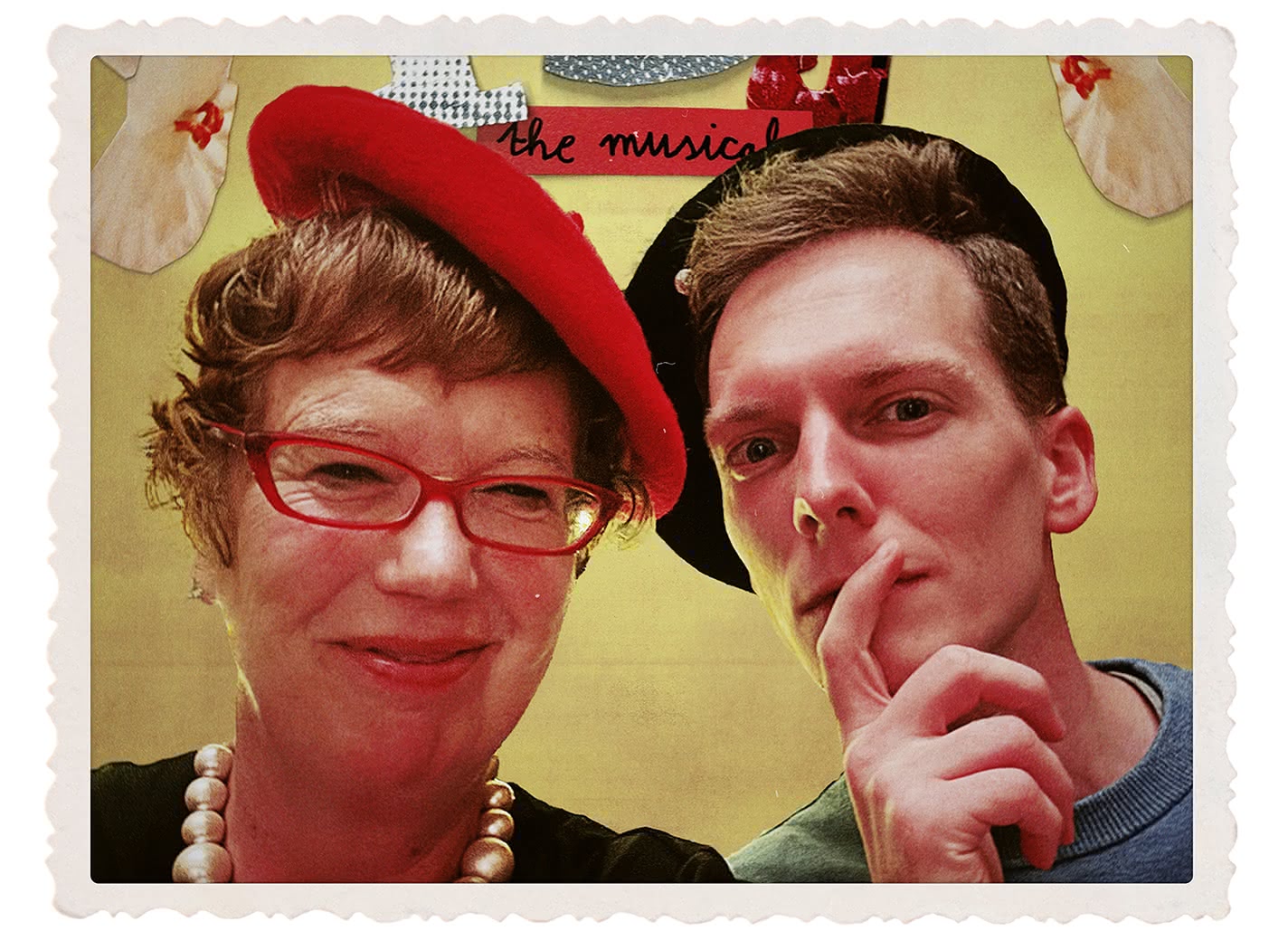
A photo of two people, cut out and set against a tan parchment-style background. On the left, a woman is wearing red sunglasses, a red beret, and a large pearl necklace. On the right, a man is wearing a black hat and looking thoughtfully into the camera.

Lorraine Bowen‘s (left) unconventional appearance on a British TV show convinced Philipp Stollenmayer (right) that she would make a note-perfect musical partner. “The humor in her music is as quirky as my games,” says Stollenmayer.

Undeterred, Bowen kept singing, winning over the live audience and judge David Walliams, who awarded her a Golden Buzzer and automatically sent her through to the next round. Stollenmayer was sold. “I thought she would be a very good fit, because the humor in her music is as quirky as my games,” he said. He emailed Bowen asking if she’d be interested in collaborating on a video game — and Bowen thought the request was coming from a child.

“I have lots of young boys writing to me all the time about being in their project,” says Bowen with a chuckle, “so, I presumed it was one of those. And I was just about to write back and say, ‘Well, you know, get in touch with your teacher, tell me about the project.’ And luckily, he said, ‘Oh, I just won an Apple Design Award.’”

“[The songs] had to be earworms. They still keep me awake all night.”

Lorraine Bowen, PBJ songwriter

They began work on a sillyfied Shakespearean origin story about peanut butter and jelly sandwiches, told through animated paper cutouts and whimsical songs. Their collaboration began with Stollenmayer providing Bowen with 10 acts’ worth of storyboards — a scaffold, as he calls it — ensuring she had the creative freedom to shape the story through her music. “It was difficult at first,” says Bowen, “because you had to lie down on a sofa, look at this massive storyboard, and think, ‘Where are we going with this?’”

Bowen spent nearly a year writing infectious tunes about a strawberry and a peanut casting off the shackles of expectations and chasing their dreams. (“They had to be earworms,” she says of the songs. “They still keep me awake all night.”) But composing a 10-act opus wasn’t the hard part. The real challenge was creating looping segments that played organically whenever a player lingered in any area of a level.

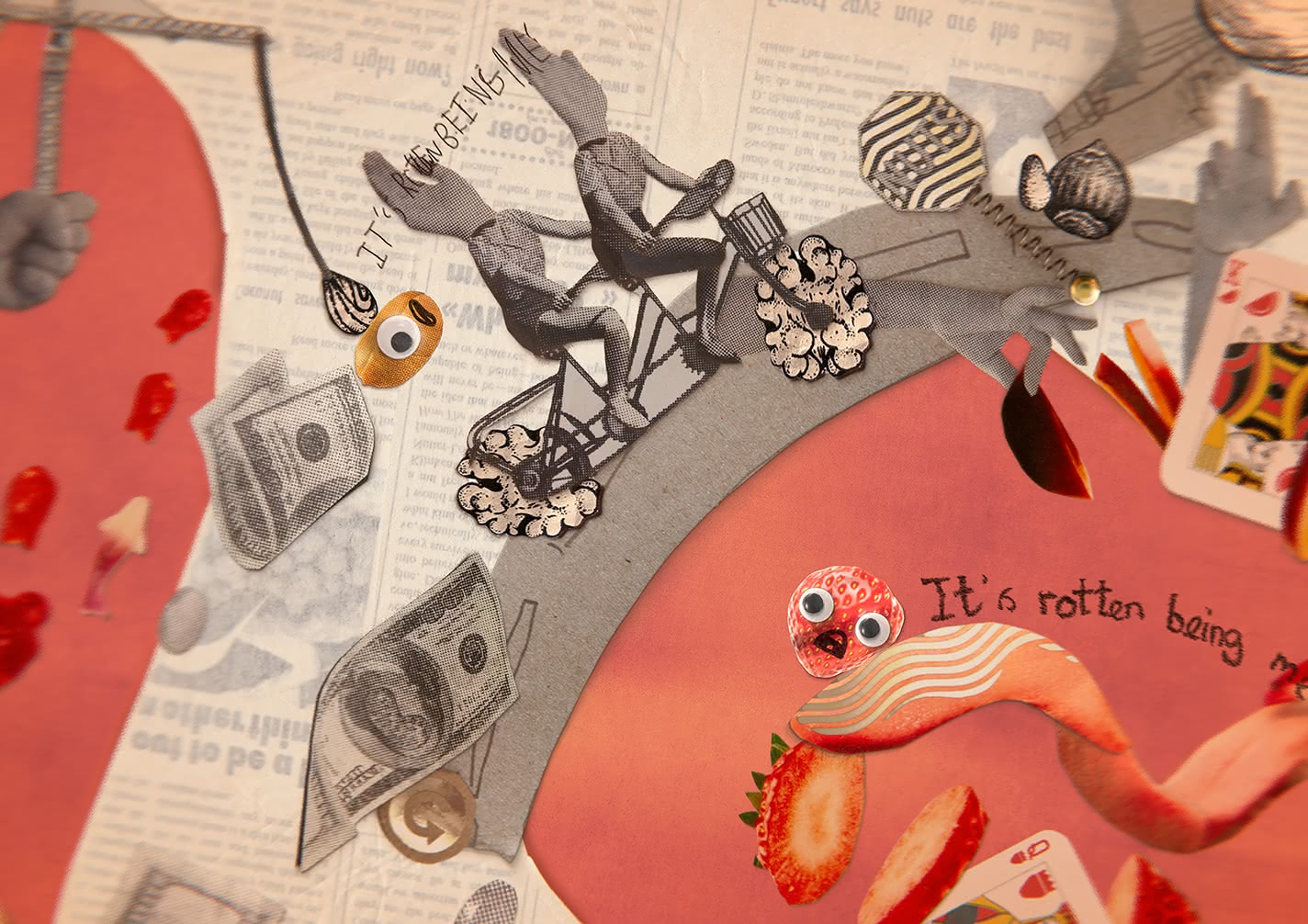
A collage of elements from the game PBJ — The Musical, which are all cut out from print publications and arranged wildly against a parchment-style background. Some elements include paper bills, playing cards, and a strawberry with a cartoon face.

Trust us, this screenshot makes total sense when you play the game.

“These weren’t songs in the rigorous, normal, verse-chorus-verse way,” she says. “They were buffers to indicate where players are coming from and where they’re going. So I had to think: Is the action physical, or emotional, or dreamy?”

Bowen fully bought into Stollenmayer’s quest for analog authenticity, recruiting musical friends to play instruments rather than relying on digital libraries. “I got out my crumhorn, recorders, whistles — anything I could,” she laughs. And the cast includes one of her piano pupils as strawberry girl, and a friend’s son — coached into an American accent — as peanut boy. The six-year-old narrator, Bowen says, was “full of sparkling mistakes” that the game lovingly preserves as noodle-letter subtitles that shuffle on corrections.

“Dirty shapes and crumpled things”

With the music locked in, it was Stollenmayer’s turn to tackle the visuals, guided by a rigid, self-imposed rule: Every asset in the game had to be physical before it became digital. “I wanted to do trashy paper stop motion,” says Stollenmayer, “and that was surprisingly difficult, because usually I have a very clean aesthetic, with circles that are really round and lines that are really flat.”

Stollenmayer printed hundreds of individual visual elements — from an off-kilter construction-paper chef to black-and-white photos of old-timey bathing beauties — and cut them out with children’s safety scissors to get delightfully imprecise edges. Then he scanned them and ran them through a custom visual shader that added crumple, gloss, and tiny inconsistencies. He even sourced reams of flimsy newsprint to get results that had the bleed and misalignment of old newspapers. “I wanted dirty shapes and crumpled things,” he says.

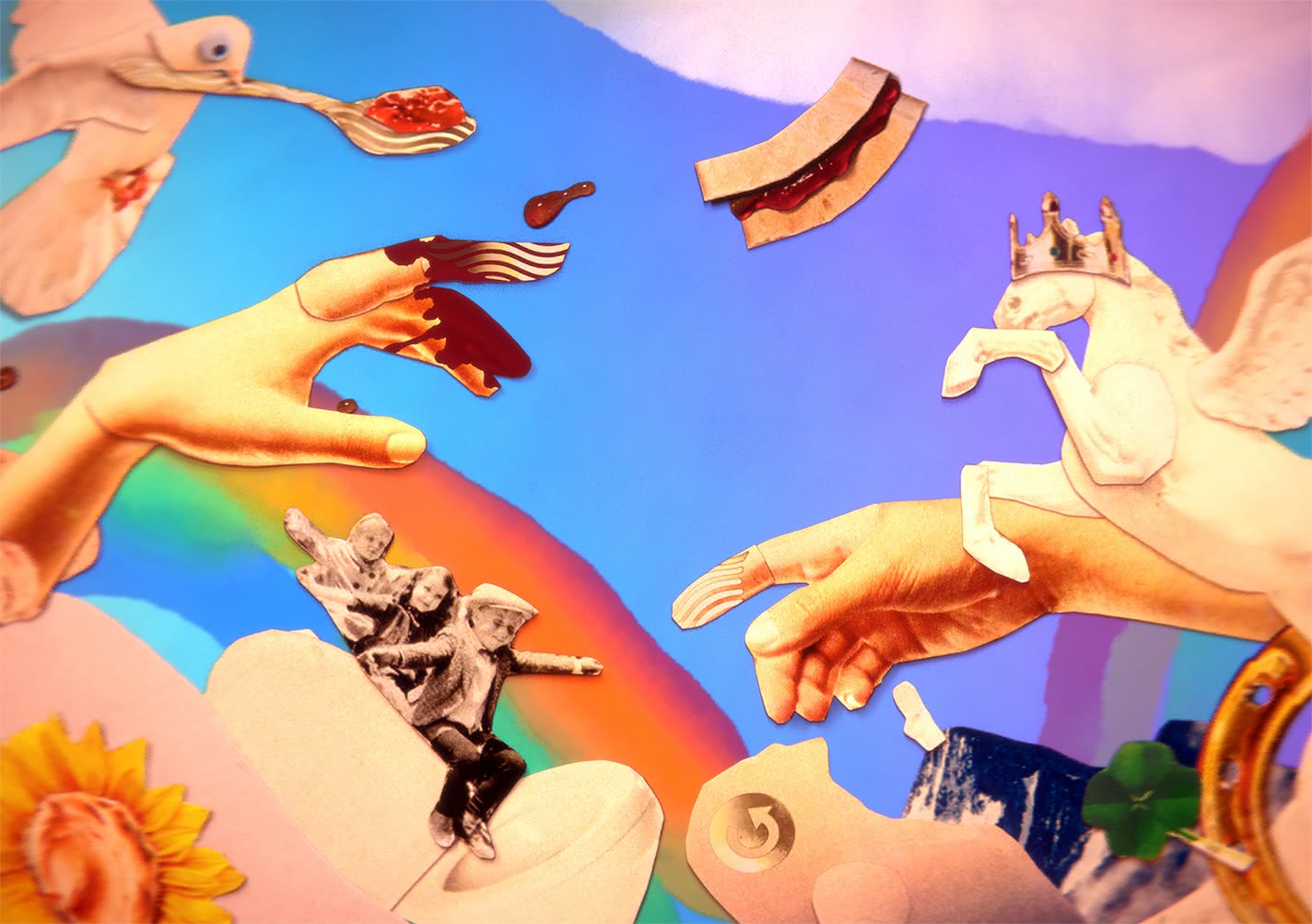
A collage of elements from the game PBJ — The Musical, which are all cut out from print publications and arranged wildly against a sky-blue background with a rainbow on it. Some elements include a horse with wings wearing a crown, children sliding, a sandwich, and a sunflower.

To create PBJ‘s incredible papercraft world, Stollenmayer collected hundreds of individual visual elements and cut them out with children’s safety scissors.

Stollenmayer spent two years on the game’s visuals before solidifying the level design and physics. “I made the strawberry fresh and squishy — she can get between gears,” he says. “The peanut is stiff and only bends on one axis; you can do more precise things with him.”

Then there’s gravity, PBJ’s secret conductor. Because nothing in a handmade collage is perfectly flat, Stollenmayer looked for a way to guide motion without breaking the illusion that the characters were bouncing along in a physical world. “The real game-changer was how gravity can shift,” he says. The game subtly nudges the character along the path that keeps the scene moving.

“Everyone is able to enjoy it”

For all its jaw-dropping showmanship, PBJ — The Musical is made for everyone. Thanks to an auto-assist feature, if a player’s hands come off the screen, a star will eventually appear and gently pull the character forward — an accessibility flourish that opens the door for non-gamers without minimizing any of the wonder. “Everyone is able to enjoy it,” he says.

That accessibility led to a surprise fan — and maybe Stollenmayer’s biggest source of pride. Because while rave reviews and awards are fantastic, nothing is quite as satisfying as getting the thumbs-up from your own mom. “I always test with her, and it’s not always the case that she enjoys playing. If she wants to play it, that’s the best feedback I can get,” says Stollenmayer. “She was glued to the screen. That was really nice to see.”

Originally published January 6, 2026
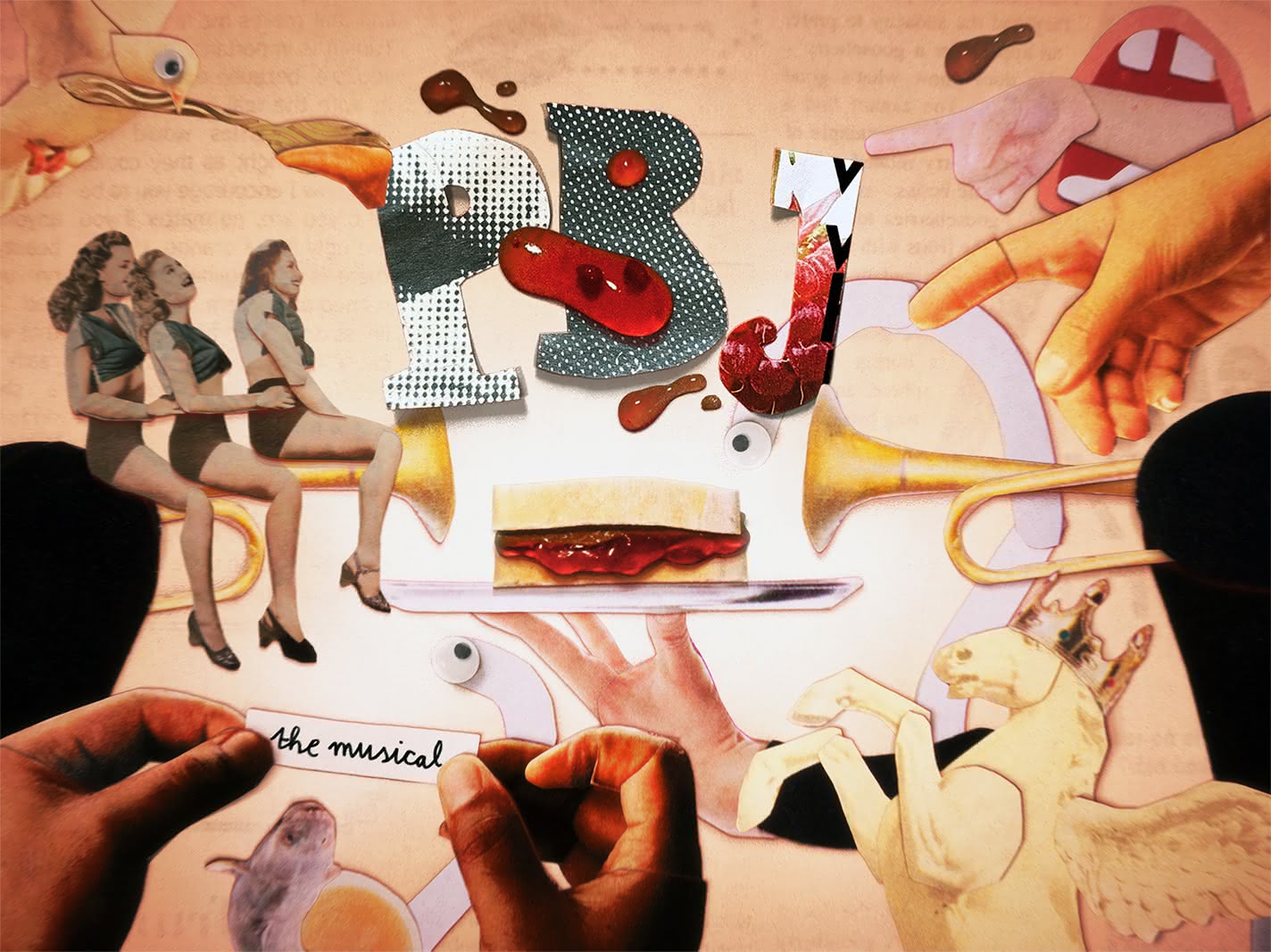
A collage of elements from the game PBJ — The Musical, which are all cut out from print publications and arranged wildly against a parchment-style background. Some elements include a trumpet, a galloping horse with wings, two pointing fingers, and the letters 'PBJ' in various backgrounds.

PEANUT BUTTER JELLY TIME

How Philipp Stollenmayer is spreading joy with PBJ – The Musical

PBJ – The Musical is a charming Apple Design Award winner with impressive production values, cool haptics, and one doozy of an elevator pitch.

“Imagine Romeo and Juliet, but it’s peanut butter and jelly,” says Philipp Stollenmayer, a papercraft pro turned founder of Kamibox, the independent German developer whose catalog includes appealing and quirky titles like Bacon: The Game, Zip-Zap, and the 2020 Apple Design Award winner Song of Bloom.

Sandwiched somewhere between narrative and game, the 2025 Apple Design Award winner for Innovation is a playful, physics-driven romp about a strawberry girl, a peanut boy, and their sweet (and savory) fate. Players gently nudge the star-crossed condiments across a handcrafted world of cutout collages — think a stack of 1950s magazines come to life through stop-motion animation — until the pair becomes the sandwich they were always meant to be.

PBJ – The Musical

Available on: iPhone, iPad
Team size: 2
Based in: Würzburg, DE
Awards: Apple Design Award winner for Innovation (2025)

Download

The pacing is theatrical (acts, reprises, a swoony duet), the visuals gloriously tactile (crinkled paper palm trees, corrugated cardboard kitchens), and the vibe somewhere between a school play and a Broadway blockbuster.

“Oh, I just won an Apple Design Award”

Stollenmayer came up with the idea years ago, but — in a stroke of metaphorical serendipity — needed a partner to truly bring his idea to life. One day, Stollenmayer was absently flicking through TV channels when he stumbled upon an episode of Britain’s Got Talent that featured quirky UK musician and songwriter Lorraine Bowen.

Fascinated, Stollenmayer watched the singer — decked out in a crinkly silver dress, oversized pearls, and red eyeglasses — as she played a Casio keyboard perched on an ironing board and sang a song about cooking a crumble, the classic British dessert. “In fact, I’ve got one in the oven,” Bowen sang. “Would you like some?” Notoriously cranky judge Simon Cowell clearly did not, slamming his red buzzer before Bowen could get through the first line. Two other judges followed suit.

A photo of two people, cut out and set against a tan parchment-style background. On the left, a woman is wearing red sunglasses, a red beret, and a large pearl necklace. On the right, a man is wearing a black hat and looking thoughtfully into the camera.

Lorraine Bowen‘s (left) unconventional appearance on a British TV show convinced Philipp Stollenmayer (right) that she would make a note-perfect musical partner. “The humor in her music is as quirky as my games,” says Stollenmayer.

Undeterred, Bowen kept singing, winning over the live audience and judge David Walliams, who awarded her a Golden Buzzer and automatically sent her through to the next round. Stollenmayer was sold. “I thought she would be a very good fit, because the humor in her music is as quirky as my games,” he said. He emailed Bowen asking if she’d be interested in collaborating on a video game — and Bowen thought the request was coming from a child.

“I have lots of young boys writing to me all the time about being in their project,” says Bowen with a chuckle, “so, I presumed it was one of those. And I was just about to write back and say, ‘Well, you know, get in touch with your teacher, tell me about the project.’ And luckily, he said, ‘Oh, I just won an Apple Design Award.’”

“[The songs] had to be earworms. They still keep me awake all night.”

Lorraine Bowen, PBJ songwriter

They began work on a sillyfied Shakespearean origin story about peanut butter and jelly sandwiches, told through animated paper cutouts and whimsical songs. Their collaboration began with Stollenmayer providing Bowen with 10 acts’ worth of storyboards — a scaffold, as he calls it — ensuring she had the creative freedom to shape the story through her music. “It was difficult at first,” says Bowen, “because you had to lie down on a sofa, look at this massive storyboard, and think, ‘Where are we going with this?’”

Bowen spent nearly a year writing infectious tunes about a strawberry and a peanut casting off the shackles of expectations and chasing their dreams. (“They had to be earworms,” she says of the songs. “They still keep me awake all night.”) But composing a 10-act opus wasn’t the hard part. The real challenge was creating looping segments that played organically whenever a player lingered in any area of a level.

A collage of elements from the game PBJ — The Musical, which are all cut out from print publications and arranged wildly against a parchment-style background. Some elements include paper bills, playing cards, and a strawberry with a cartoon face.

Trust us, this screenshot makes total sense when you play the game.

“These weren’t songs in the rigorous, normal, verse-chorus-verse way,” she says. “They were buffers to indicate where players are coming from and where they’re going. So I had to think: Is the action physical, or emotional, or dreamy?”

Bowen fully bought into Stollenmayer’s quest for analog authenticity, recruiting musical friends to play instruments rather than relying on digital libraries. “I got out my crumhorn, recorders, whistles — anything I could,” she laughs. And the cast includes one of her piano pupils as strawberry girl, and a friend’s son — coached into an American accent — as peanut boy. The six-year-old narrator, Bowen says, was “full of sparkling mistakes” that the game lovingly preserves as noodle-letter subtitles that shuffle on corrections.

“Dirty shapes and crumpled things”

With the music locked in, it was Stollenmayer’s turn to tackle the visuals, guided by a rigid, self-imposed rule: Every asset in the game had to be physical before it became digital. “I wanted to do trashy paper stop motion,” says Stollenmayer, “and that was surprisingly difficult, because usually I have a very clean aesthetic, with circles that are really round and lines that are really flat.”

Stollenmayer printed hundreds of individual visual elements — from an off-kilter construction-paper chef to black-and-white photos of old-timey bathing beauties — and cut them out with children’s safety scissors to get delightfully imprecise edges. Then he scanned them and ran them through a custom visual shader that added crumple, gloss, and tiny inconsistencies. He even sourced reams of flimsy newsprint to get results that had the bleed and misalignment of old newspapers. “I wanted dirty shapes and crumpled things,” he says.

A collage of elements from the game PBJ — The Musical, which are all cut out from print publications and arranged wildly against a sky-blue background with a rainbow on it. Some elements include a horse with wings wearing a crown, children sliding, a sandwich, and a sunflower.

To create PBJ‘s incredible papercraft world, Stollenmayer collected hundreds of individual visual elements and cut them out with children’s safety scissors.

Stollenmayer spent two years on the game’s visuals before solidifying the level design and physics. “I made the strawberry fresh and squishy — she can get between gears,” he says. “The peanut is stiff and only bends on one axis; you can do more precise things with him.”

Then there’s gravity, PBJ’s secret conductor. Because nothing in a handmade collage is perfectly flat, Stollenmayer looked for a way to guide motion without breaking the illusion that the characters were bouncing along in a physical world. “The real game-changer was how gravity can shift,” he says. The game subtly nudges the character along the path that keeps the scene moving.

“Everyone is able to enjoy it”

For all its jaw-dropping showmanship, PBJ — The Musical is made for everyone. Thanks to an auto-assist feature, if a player’s hands come off the screen, a star will eventually appear and gently pull the character forward — an accessibility flourish that opens the door for non-gamers without minimizing any of the wonder. “Everyone is able to enjoy it,” he says.

That accessibility led to a surprise fan — and maybe Stollenmayer’s biggest source of pride. Because while rave reviews and awards are fantastic, nothing is quite as satisfying as getting the thumbs-up from your own mom. “I always test with her, and it’s not always the case that she enjoys playing. If she wants to play it, that’s the best feedback I can get,” says Stollenmayer. “She was glued to the screen. That was really nice to see.”

Originally published January 6, 2026
Developer Footer

  • Articles
  • How Philipp Stollenmayer is spreading joy with PBJ – The Musical
  • Open Menu Close Menu
    • iOS
    • iPadOS
    • macOS
    • tvOS
    • visionOS
    • watchOS
    Open Menu Close Menu
    • Swift
    • SwiftUI
    • Swift Playground
    • TestFlight
    • Xcode
    • Xcode Cloud
    • Icon Composer
    • SF Symbols
    Open Menu Close Menu
    • Accessibility
    • Accessories
    • Apple Intelligence
    • App Store
    • Audio & Video
    • Augmented Reality
    • Business
    • Design
    • Distribution
    • Education
    • Fonts
    • Games
    • Health & Fitness
    • In-App Purchase
    • Localization
    • Maps & Location
    • Machine Learning & AI
    • Open Source
    • Security
    • Safari & Web
    Open Menu Close Menu
    • Documentation
    • Sample Code
    • Tutorials
    • Downloads
    • Forums
    • Videos
    Open Menu Close Menu
    • Support Articles
    • Contact Us
    • Bug Reporting
    • System Status
    Open Menu Close Menu
    • Apple Developer
    • App Store Connect
    • Certificates, IDs, & Profiles
    • Feedback Assistant
    Open Menu Close Menu
    • Apple Developer Program
    • Apple Developer Enterprise Program
    • App Store Small Business Program
    • MFi Program
    • Mini Apps Partner Program
    • News Partner Program
    • Video Partner Program
    • Security Bounty Program
    • Security Research Device Program
    Open Menu Close Menu
    • Meet with Apple
    • Apple Developer Centers
    • App Store Awards
    • Apple Design Awards
    • Apple Developer Academies
    • WWDC
    Get the Apple Developer app.
    Copyright © 2026 Apple Inc. All rights reserved.
    Terms of Use Privacy Policy Agreements and Guidelines