-
Meet AsyncSequence
Iterating over a sequence of values over time is now as easy as writing a “for” loop. Find out how the new AsyncSequence protocol enables a natural, simple syntax for iterating over anything from notifications to bytes being streamed from a server. We'll also show you how to adapt existing code to provide asynchronous sequences of your own.
To get the most out of this session, we recommend first watching “Meet async/await in Swift.”Recursos
- SE-0314: AsyncStream and AsyncThrowingStream
- SE-0298: Async/Await: Sequences
- The Swift Programming Language: Concurrency
Vídeos relacionados
WWDC22
- Compose advanced models with Create ML Components
- Create a more responsive media app
- Meet Swift Async Algorithms
WWDC21
-
Buscar neste vídeo...
-
-
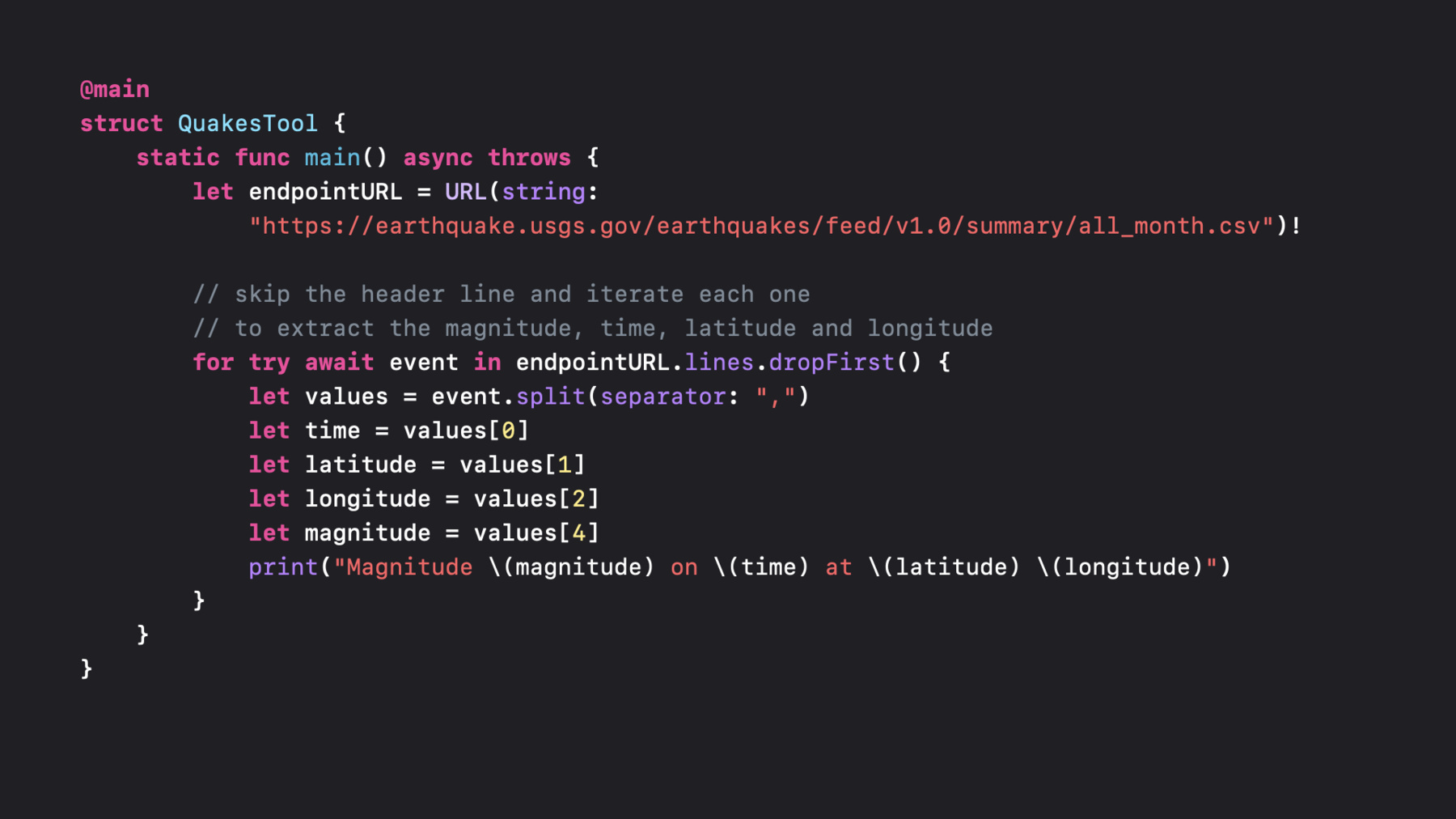
0:37 - QuakesTool
@main struct QuakesTool { static func main() async throws { let endpointURL = URL(string: "https://earthquake.usgs.gov/earthquakes/feed/v1.0/summary/all_month.csv")! // skip the header line and iterate each one // to extract the magnitude, time, latitude and longitude for try await event in endpointURL.lines.dropFirst() { let values = event.split(separator: ",") let time = values[0] let latitude = values[1] let longitude = values[2] let magnitude = values[4] print("Magnitude \(magnitude) on \(time) at \(latitude) \(longitude)") } } } -
3:24 - Iterating a Sequence
for quake in quakes { if quake.magnitude > 3 { displaySignificantEarthquake(quake) } } -
3:52 - How the compiler handles iteration
var iterator = quakes.makeIterator() while let quake = iterator.next() { if quake.magnitude > 3 { displaySignificantEarthquake(quake) } } -
4:11 - How the compiler handles asynchronous iteration
var iterator = quakes.makeAsyncIterator() while let quake = await iterator.next() { if quake.magnitude > 3 { displaySignificantEarthquake(quake) } } -
4:28 - Iterating an AsyncSequence
for await quake in quakes { if quake.magnitude > 3 { displaySignificantEarthquake(quake) } } -
5:36 - Terminating iteration early by breaking
for await quake in quakes { if quake.location == nil { break } if quake.magnitude > 3 { displaySignificantEarthquake(quake) } } -
5:51 - Skipping values by continuing
for await quake in quakes { if quake.depth > 5 { continue } if quake.magnitude > 3 { displaySignificantEarthquake(quake) } } -
6:05 - AsyncSequence might throw
do { for try await quake in quakeDownload { ... } } catch { ... } -
7:15 - Concurrently iterating inside an async task
let iteration1 = Task { for await quake in quakes { ... } } let iteration2 = Task { do { for try await quake in quakeDownload { ... } } catch { ... } } //... later on iteration1.cancel() iteration2.cancel() -
7:56 - Reading bytes from a FileHandle
for try await line in FileHandle.standardInput.bytes.lines { ... } -
8:16 - Reading lines from a URL
let url = URL(fileURLWithPath: "/tmp/somefile.txt") for try await line in url.lines { ... } -
8:49 - Reading bytes from a URLSession
let (bytes, response) = try await URLSession.shared.bytes(from: url) guard let httpResponse = response as? HTTPURLResponse, httpResponse.statusCode == 200 /* OK */ else { throw MyNetworkingError.invalidServerResponse } for try await byte in bytes { ... } -
9:12 - Notifications
let center = NotificationCenter.default let notification = await center.notifications(named: .NSPersistentStoreRemoteChange).first { $0.userInfo[NSStoreUUIDKey] == storeUUID } -
11:10 - Using an AsyncStream
class QuakeMonitor {
    var quakeHandler: (Quake) -> Void
    func startMonitoring()
    func stopMonitoring()
}

let quakes = AsyncStream(Quake.self) { continuation in
    let monitor = QuakeMonitor()
    monitor.quakeHandler = { quake in
        continuation.yield(quake)
    }
    continuation.onTermination = { @Sendable _ in
        monitor.stopMonitoring()
    }
    monitor.startMonitoring()
}

let significantQuakes = quakes.filter { quake in
    quake.magnitude > 3
}

for await quake in significantQuakes {
    ...
}
-