

-
What’s new in voice processing
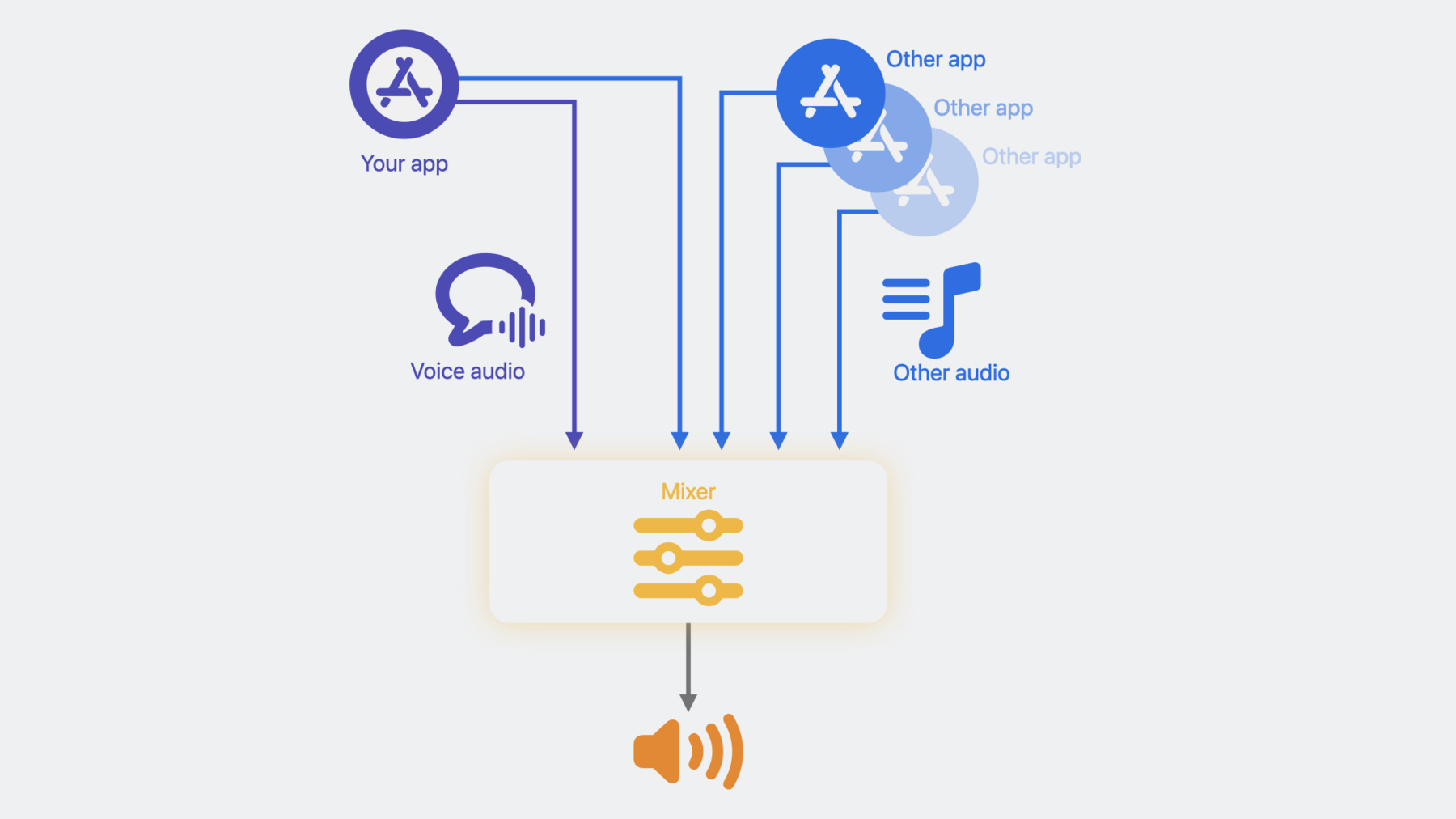
Learn how to use the Apple voice processing APIs to achieve the best possible audio experience in your VoIP apps. We'll show you how to detect when someone is talking while muted, adjust ducking behavior of other audio, and more.
Capítulos
- 0:00 - Introduction
- 3:19 - Other audio ducking
- 7:55 - Muted talker detection
- 11:37 - Muted talker detection for macOS
Recursos
Vídeos relacionados
WWDC23
-
Buscar neste vídeo...
-
-
5:50 - Other audio ducking
// Insert code snipp297struct AUVoiceIOOtherAudioDuckingConfiguration { Boolean mEnableAdvancedDucking; AUVoiceIOOtherAudioDuckingLevel mDuckingLevel; };et. typedef CF_ENUM(UInt32, AUVoiceIOOtherAudioDuckingLevel) { kAUVoiceIOOtherAudioDuckingLevelDefault = 0, kAUVoiceIOOtherAudioDuckingLevelMin = 10, kAUVoiceIOOtherAudioDuckingLevelMid = 20, kAUVoiceIOOtherAudioDuckingLevelMax = 30 }; -
6:48 - Other audio ducking
const AUVoiceIOOtherAudioDuckingConfiguration duckingConfig = { .mEnableAdvancedDucking = true, .mDuckingLevel = AUVoiceIOOtherAudioDuckingLevel::kAUVoiceIOOtherAudioDuckingLevelMin }; // AUVoiceIO creation code omitted OSStatus err = AudioUnitSetProperty(auVoiceIO, kAUVoiceIOProperty_OtherAudioDuckingConfiguration, kAudioUnitScope_Global, 0, &duckingConfig, sizeof(duckingConfig)); -
6:50 - Other audio ducking
const AUVoiceIOOtherAudioDuckingConfiguration duckingConfig = { .mEnableAdvancedDucking = true, .mDuckingLevel = AUVoiceIOOtherAudioDuckingLevel::kAUVoiceIOOtherAudioDuckingLevelMin }; // AUVoiceIO creation code omitted OSStatus err = AudioUnitSetProperty(auVoiceIO, kAUVoiceIOProperty_OtherAudioDuckingConfiguration, kAudioUnitScope_Global, 0, &duckingConfig, sizeof(duckingConfig)); -
7:20 - Other audio ducking
public struct AVAudioVoiceProcessingOtherAudioDuckingConfiguration { public var enableAdvancedDucking: ObjCBool public var duckingLevel: AVAudioVoiceProcessingOtherAudioDuckingConfiguration.Level } extension AVAudioVoiceProcessingOtherAudioDuckingConfiguration { public enum Level : Int, @unchecked Sendable { case `default` = 0 case min = 10 case mid = 20 case max = 30 } } -
7:31 - Other audio ducking
let engine = AVAudioEngine() let inputNode = engine.inputNode do { try inputNode.setVoiceProcessingEnabled(true) } catch { print("Could not enable voice processing \(error)") } let duckingConfig = AVAudioVoiceProcessingOtherAudioDuckingConfiguration(mEnableAdvancedDucking: false, mDuckingLevel: .max) inputNode.voiceProcessingOtherAudioDuckingConfiguration = duckingConfig -
7:32 - Muted talker detection AUVoiceIO
AUVoiceIOMutedSpeechActivityEventListener listener = ^(AUVoiceIOMutedSpeechActivityEvent event) { if (event == kAUVoiceIOSpeechActivityHasStarted) { // User has started talking while muted. Prompt the user to un-mute } else if (event == kAUVoiceIOSpeechActivityHasEnded) { // User has stopped talking while muted } }; OSStatus err = AudioUnitSetProperty(auVoiceIO, kAUVoiceIOProperty_MutedSpeechActivityEventListener, kAudioUnitScope_Global, 0, &listener, sizeof(AUVoiceIOMutedSpeechActivityEventListener)); // When user mutes UInt32 muteUplinkOutput = 1; result = AudioUnitSetProperty(auVoiceIO, kAUVoiceIOProperty_MuteOutput, kAudioUnitScope_Global, 0, &muteUplinkOutput, sizeof(muteUplinkOutput)); -
11:08 - Muted talker detection AVAudioEngine
let listener = { (event : AVAudioVoiceProcessingSpeechActivityEvent) in if (event == AVAudioVoiceProcessingSpeechActivityEvent.started) { // User has started talking while muted. Prompt the user to un-mute } else if (event == AVAudioVoiceProcessingSpeechActivityEvent.ended) { // User has stopped talking while muted } } inputNode.setMutedSpeechActivityEventListener(listener) // When user mutes inputNode.isVoiceProcessingInputMuted = true -
12:31 - Voice activity detection - implementation with HAL APIs
// Enable Voice Activity Detection on the input device const AudioObjectPropertyAddress kVoiceActivityDetectionEnable{ kAudioDevicePropertyVoiceActivityDetectionEnable, kAudioDevicePropertyScopeInput, kAudioObjectPropertyElementMain }; OSStatus status = kAudioHardwareNoError; UInt32 shouldEnable = 1; status = AudioObjectSetPropertyData(deviceID, &kVoiceActivityDetectionEnable, 0, NULL, sizeof(UInt32), &shouldEnable); // Register a listener on the Voice Activity Detection State property const AudioObjectPropertyAddress kVoiceActivityDetectionState{ kAudioDevicePropertyVoiceActivityDetectionState, kAudioDevicePropertyScopeInput, kAudioObjectPropertyElementMain }; status = AudioObjectAddPropertyListener(deviceID, &kVoiceActivityDetectionState, (AudioObjectPropertyListenerProc)listener_callback, NULL); // “listener_callback” is the name of your listener function -
13:13 - Voice activity detection - listener_callback implementation
OSStatus listener_callback(
    AudioObjectID                 inObjectID,
    UInt32                        inNumberAddresses,
    const AudioObjectPropertyAddress*   __nullable inAddresses,
    void* __nullable              inClientData)
{
  // Assuming this is the only property we are listening for, therefore no need to go through inAddresses
       UInt32 voiceDetected = 0;
     UInt32 propertySize = sizeof(UInt32);
     OSStatus status = AudioObjectGetPropertyData(inObjectID, &kVoiceActivityState, 0, NULL, &propertySize, &voiceDetected);

       if (kAudioHardwareNoError == status) {
 if (voiceDetected == 1) {
    // voice activity detected
	} else if (voiceDetected == 0) {
		    // voice activity not detected
	}
 }
 return status;
};
-