

-
Build a spatial drawing app with RealityKit
Harness the power of RealityKit through the process of building a spatial drawing app. As you create an eye-catching spatial experience that integrates RealityKit with ARKit and SwiftUI, you'll explore how resources work in RealityKit and how to use features like low-level mesh and texture APIs to achieve fast updates of the users' brush strokes.
Capítulos
- 0:00 - Introduction
- 2:43 - Set up spatial tracking
- 5:42 - Build a spatial user interface
- 13:57 - Generate brush geometry
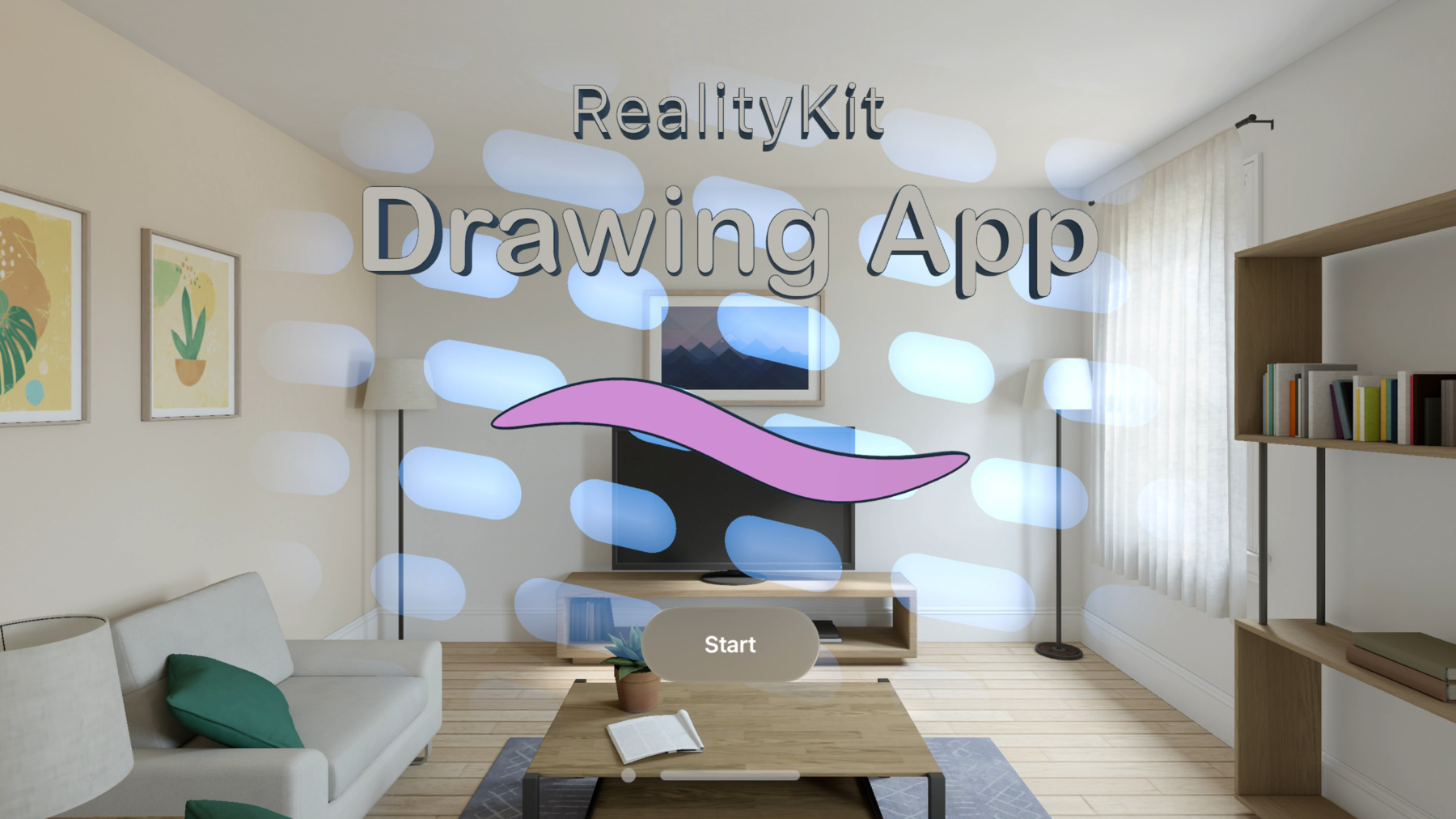
- 26:11 - Create a splash screen
Recursos
Vídeos relacionados
WWDC24
- Compose interactive 3D content in Reality Composer Pro
- Create custom hover effects in visionOS
- Discover RealityKit APIs for iOS, macOS, and visionOS
- Enhance your spatial computing app with RealityKit audio
WWDC23
-
Buscar neste vídeo...
-
-
4:18 - Using SpatialTrackingSession
// Retain the SpatialTrackingSession while your app needs access let session = SpatialTrackingSession() // Declare needed tracking capabilities let configuration = SpatialTrackingSession.Configuration(tracking: [.hand]) // Request authorization for spatial tracking let unapprovedCapabilities = await session.run(configuration) if let unapprovedCapabilities, unapprovedCapabilities.anchor.contains(.hand) { // User has rejected hand data for your app. // AnchorEntities will continue to remain anchored and update visually // However, AnchorEntity.transform will not receive updates } else { // User has approved hand data for your app. // AnchorEntity.transform will report hand anchor pose } -
7:07 - Use MeshResource extrusion
// Use MeshResource(extruding:) to generate the canvas edge let path = SwiftUI.Path { path in // Generate two concentric circles as a SwiftUI.Path path.addArc(center: .zero, radius: outerRadius, startAngle: .degrees(0), endAngle: .degrees(360), clockwise: true) path.addArc(center: .zero, radius: innerRadius, startAngle: .degrees(0), endAngle: .degrees(360), clockwise: true) }.normalized(eoFill: true) var options = MeshResource.ShapeExtrusionOptions() options.boundaryResolution = .uniformSegmentsPerSpan(segmentCount: 64) options.extrusionMethod = .linear(depth: extrusionDepth) return try MeshResource(extruding: path, extrusionOptions: extrusionOptions) -
9:33 - Highlight HoverEffectComponent
// Use HoverEffectComponent with .highlight let placementEntity: Entity = // ... let hover = HoverEffectComponent( .highlight(.init( color: UIColor(/* ... */), strength: 5.0) ) ) placementEntity.components.set(hover) -
9:54 - Using Blend Modes
// Create an UnlitMaterial with Additive Blend Mode var descriptor = UnlitMaterial.Program.Descriptor() descriptor.blendMode = .add let prog = await UnlitMaterial.Program(descriptor: descriptor) var material = UnlitMaterial(program: prog) material.color = UnlitMaterial.BaseColor(tint: UIColor(/* ... */)) -
13:45 - Shader based hover effects
// Use shader-based hover effects let hoverEffectComponent = HoverEffectComponent(.shader(.default)) entity.components.set(hoverEffectComponent) let material = try await ShaderGraphMaterial(named: "/Root/SolidPresetBrushMaterial", from: "PresetBrushMaterial", in: realityKitContentBundle) entity.components.set(ModelComponent(mesh: /* ... */, materials: [material])) -
16:56 - Defining a vertex buffer struct for the solid brush
struct SolidBrushVertex { packed_float3 position; packed_float3 normal; packed_float3 bitangent; packed_float2 materialProperties; float curveDistance; packed_half3 color; }; -
19:27 - Defining LowLevelMesh Attributes for solid brush
extension SolidBrushVertex { static var vertexAttributes: [LowLevelMesh.Attribute] { typealias Attribute = LowLevelMesh.Attribute return [ Attribute(semantic: .position, format: MTLVertexFormat.float3, layoutIndex: 0, offset: MemoryLayout.offset(of: \Self.position)!), Attribute(semantic: .normal, format: MTLVertexFormat.float3, layoutIndex: 0, offset: MemoryLayout.offset(of: \Self.normal)!), Attribute(semantic: .bitangent, format: MTLVertexFormat.float3, layoutIndex: 0, offset: MemoryLayout.offset(of: \Self.bitangent)!), Attribute(semantic: .color, format: MTLVertexFormat.half3, layoutIndex: 0, offset: MemoryLayout.offset(of: \Self.color)!), Attribute(semantic: .uv1, format: MTLVertexFormat.float, layoutIndex: 0, offset: MemoryLayout.offset(of: \Self.curveDistance)!), Attribute(semantic: .uv3, format: MTLVertexFormat.float2, layoutIndex: 0, offset: MemoryLayout.offset(of: \Self.materialProperties)!) ] } } -
21:14 - Make LowLevelMesh
private static func makeLowLevelMesh(vertexBufferSize: Int, indexBufferSize: Int, meshBounds: BoundingBox) throws -> LowLevelMesh { var descriptor = LowLevelMesh.Descriptor() // Similar to MTLVertexDescriptor descriptor.vertexCapacity = vertexBufferSize descriptor.indexCapacity = indexBufferSize descriptor.vertexAttributes = SolidBrushVertex.vertexAttributes let stride = MemoryLayout<SolidBrushVertex>.stride descriptor.vertexLayouts = [LowLevelMesh.Layout(bufferIndex: 0, bufferOffset: 0, bufferStride: stride)] let mesh = try LowLevelMesh(descriptor: descriptor) mesh.parts.append(LowLevelMesh.Part(indexOffset: 0, indexCount: indexBufferSize, topology: .triangleStrip, materialIndex: 0, bounds: meshBounds)) return mesh } -
22:28 - Creating a MeshResource
let mesh: LowLevelMesh let resource = try MeshResource(from: mesh) entity.components[ModelComponent.self] = ModelComponent(mesh: resource, materials: [...]) -
22:37 - Updating vertex data of LowLevelMesh using withUnsafeMutableBytes API
let mesh: LowLevelMesh mesh.withUnsafeMutableBytes(bufferIndex: 0) { buffer in let vertices: UnsafeMutableBufferPointer<SolidBrushVertex> = buffer.bindMemory(to: SolidBrushVertex.self) // Write to vertex buffer `vertices` } -
23:07 - Updating LowLevelMesh index buffers using withUnsafeMutableBytes API
let mesh: LowLevelMesh mesh.withUnsafeMutableIndices { buffer in let indices: UnsafeMutableBufferPointer<UInt32> = buffer.bindMemory(to: UInt32.self) // Write to index buffer `indices` } -
23:58 - Creating a particle brush using LowLevelMesh
struct SparkleBrushAttributes { packed_float3 position; packed_half3 color; float curveDistance; float size; }; // Describes a particle in the simulation struct SparkleBrushParticle { struct SparkleBrushAttributes attributes; packed_float3 velocity; }; // One quad (4 vertices) is created per particle struct SparkleBrushVertex { struct SparkleBrushAttributes attributes; simd_half2 uv; }; -
24:58 - Defining LowLevelMesh Attributes for sparkle brush
extension SparkleBrushVertex { static var vertexAttributes: [LowLevelMesh.Attribute] { typealias Attribute = LowLevelMesh.Attribute return [ Attribute(semantic: .position, format: .float3, layoutIndex: 0, offset: MemoryLayout.offset(of: \Self.attributes.position)!), Attribute(semantic: .color, format: .half3, layoutIndex: 0, offset: MemoryLayout.offset(of: \Self.attributes.color)!), Attribute(semantic: .uv0, format: .half2, layoutIndex: 0, offset: MemoryLayout.offset(of: \Self.uv)!), Attribute(semantic: .uv1, format: .float, layoutIndex: 0, offset: MemoryLayout.offset(of: \Self.attributes.curveDistance)!), Attribute(semantic: .uv2, format: .float, layoutIndex: 0, offset: MemoryLayout.offset(of: \Self.attributes.size)!) ] } } -
25:28 - Populate LowLevelMesh on GPU
let inputParticleBuffer: MTLBuffer let lowLevelMesh: LowLevelMesh let commandBuffer: MTLCommandBuffer let encoder: MTLComputeCommandEncoder let populatePipeline: MTLComputePipelineState commandBuffer.enqueue() encoder.setComputePipelineState(populatePipeline) let vertexBuffer: MTLBuffer = lowLevelMesh.replace(bufferIndex: 0, using: commandBuffer) encoder.setBuffer(inputParticleBuffer, offset: 0, index: 0) encoder.setBuffer(vertexBuffer, offset: 0, index: 1) encoder.dispatchThreadgroups(/* ... */) // ... encoder.endEncoding() commandBuffer.commit() -
27:01 - Use MeshResource extrusion to generate 3D text
// Use MeshResource(extruding:) to generate 3D text var textString = AttributedString("RealityKit") textString.font = .systemFont(ofSize: 8.0) let secondLineFont = UIFont(name: "ArialRoundedMTBold", size: 14.0) let attributes = AttributeContainer([.font: secondLineFont]) textString.append(AttributedString("\nDrawing App", attributes: attributes)) let paragraphStyle = NSMutableParagraphStyle() paragraphStyle.alignment = .center let centerAttributes = AttributeContainer([.paragraphStyle: paragraphStyle]) textString.mergeAttributes(centerAttributes) var extrusionOptions = MeshResource.ShapeExtrusionOptions() extrusionOptions.extrusionMethod = .linear(depth: 2) extrusionOptions.materialAssignment = .init(front: 0, back: 0, extrusion: 1, frontChamfer: 1, backChamfer: 1) extrusionOptions.chamferRadius = 0.1 let textMesh = try await MeshResource(extruding: textString extrusionOptions: extrusionOptions) -
28:25 - Use MeshResource extrusion to turn a SwiftUI Path into 3D mesh
// Use MeshResource(extruding:) to bring SwiftUI.Path to 3D let graphic = SwiftUI.Path { path in path.move(to: CGPoint(x: -0.7, y: 0.135413)) path.addCurve(to: CGPoint(x: -0.7, y: 0.042066), control1: CGPoint(x: -0.85, y: 0.067707), control2: CGPoint(x: -0.85, y: 0.021033)) // ... } var options = MeshResource.ShapeExtrusionOptions() // ... let graphicMesh = try await MeshResource(extruding: graphic extrusionOptions: options) -
29:44 - Defining a LowLevelTexture
let descriptor = LowLevelTexture.Descriptor(pixelFormat: .rg16Float, width: textureResolution, height: textureResolution, textureUsage: [.shaderWrite, .shaderRead]) let lowLevelTexture = try LowLevelTexture(descriptor: descriptor) var textureResource = try TextureResource(from: lowLevelTexture) var material = UnlitMaterial() material.color = .init(tint: .white, texture: .init(textureResource)) -
30:27 - Update a LowLevelTexture on the GPU
let lowLevelTexture: LowLevelTexture

let commandBuffer: MTLCommandBuffer
let encoder: MTLComputeCommandEncoder
let computePipeline: MTLComputePipelineState

commandBuffer.enqueue()
encoder.setComputePipelineState(computePipeline)

let writeTexture: MTLTexture = lowLevelTexture.replace(using: commandBuffer)
encoder.setTexture(writeTexture, index: 0)

// ...

encoder.dispatchThreadgroups(/* ... */)
encoder.endEncoding()
commandBuffer.commit()
-