

-
Demystify SwiftUI performance
Learn how you can build a mental model for performance in SwiftUI and write faster, more efficient code. We'll share some of the common causes behind performance issues and help you triage hangs and hitches in SwiftUI to create more responsive views in your app.
Chapitres
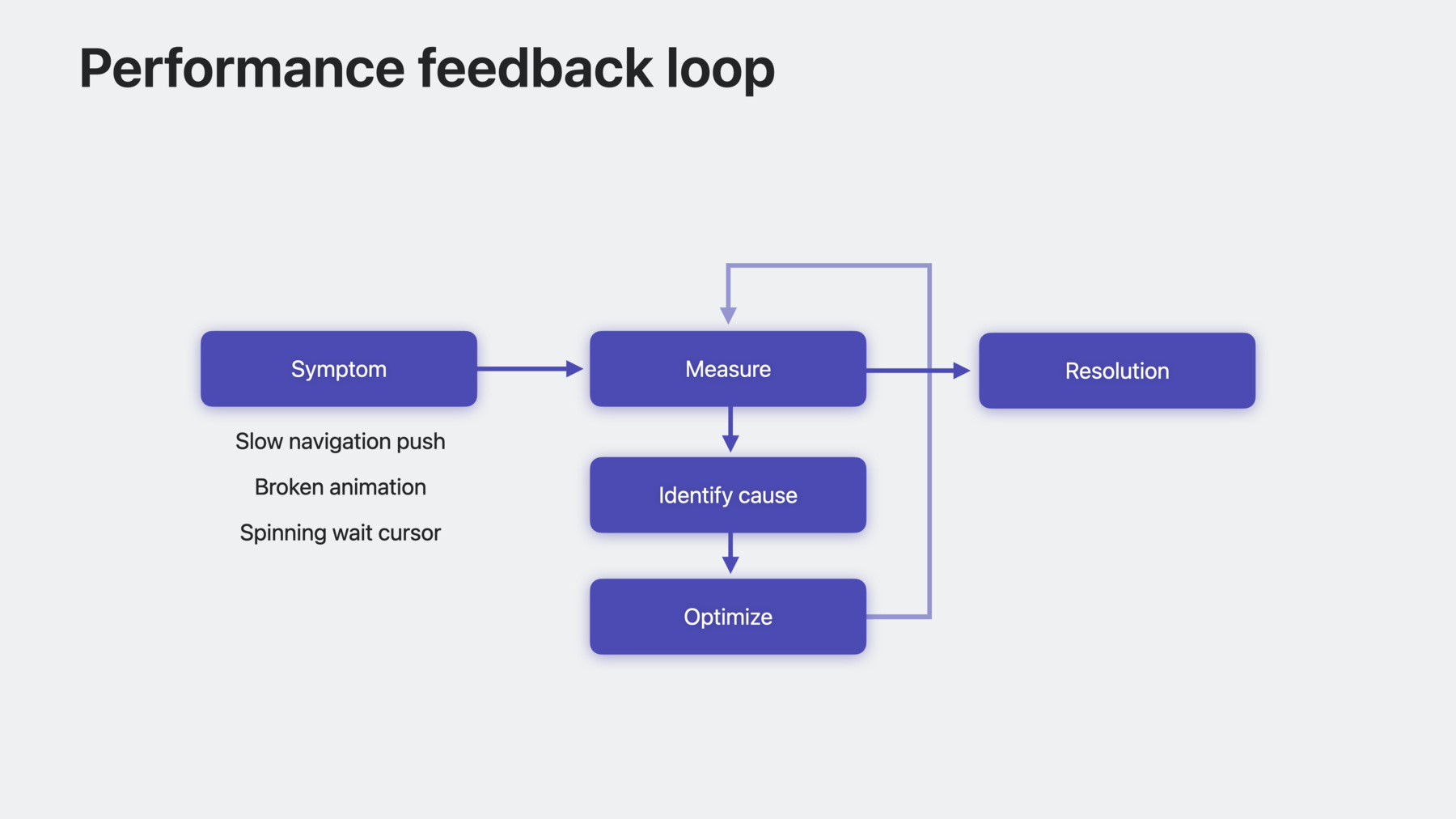
- 0:00 - Introduction and performance feedback loop
- 3:30 - Dependencies
- 10:48 - Faster view updates
- 13:24 - Identity in List and Table
Ressources
Vidéos connexes
WWDC23
WWDC21
Tech Talks
-
Rechercher dans cette vidéo…
-
-
3:59 - DogView
struct DogView: View { @Environment(\.isPlayTime) private var isPlayTime var dog: Dog var body: some View { Text(dog.name) .font(nameFont) Text(dog.breed) .font(breedFont) .foregroundStyle(.secondary) ScalableDogImage(dog) DogDetailView(dog) LetsPlayButton() .disabled(dog.isTired) } } } -
4:00 - ScalableDogImage
struct ScalableDogImage: View { @State private var scaleToFill = false var dog: Dog var body: some View { dog.image .resizable() .aspectRatio( contentMode: scaleToFill ? .fill : .fit) .frame(maxHeight: scaleToFill ? 500 : nil) .padding(.vertical, 16) .onTapGesture { withAnimation { scaleToFill.toggle() } } } } -
4:01 - printChanges
expression Self._printChanges() -
4:02 - ScalableDogImage + printChanges
struct ScalableDogImage: View { @State private var scaleToFill = false var dog: Dog var body: some View { let _ = Self._printChanges() dog.image .resizable() .aspectRatio( contentMode: scaleToFill ? .fill : .fit) .frame(maxHeight: scaleToFill ? 500 : nil) .padding(.vertical, 16) .onTapGesture { withAnimation { scaleToFill.toggle() } } } } -
8:46 - ScaleableDogImage
struct ScalableDogImage: View { @State private var scaleToFill = false var dog: Dog var body: some View { dog.image .resizable() .aspectRatio( contentMode: scaleToFill ? .fill : .fit) .frame(maxHeight: scaleToFill ? 500 : nil) .padding(.vertical, 16) .onTapGesture { withAnimation { scaleToFill.toggle() } } } } -
8:47 - Updated DogView
struct DogView: View { @Environment(\.isPlayTime) private var isPlayTime var dog: Dog var body: some View { Text(dog.name) .font(nameFont) Text(dog.breed) .font(breedFont) .foregroundStyle(.secondary) ScalableDogImage(dog) DogDetailView(dog) LetsPlayButton() .disabled(dog.isTired) } } } -
8:48 - Final DogView
struct DogView: View { @Environment(\.isPlayTime) private var isPlayTime var dog: Dog var body: some View { DogHeader(name: dog.name, breed: dog.breed) ScalableDogImage(dog.image) DogDetailView(dog) LetsPlayButton() .disabled(dog.isTired) } } } -
12:22 - DogRootView and FetchModel
struct DogRootView: View { @State private var model = FetchModel() var body: some View { DogList(model.dogs) } } @Observable class FetchModel { var dogs: [Dog] init() { fetchDogs() } func fetchDogs() { // Takes a long time } } -
12:23 - Updated DogRootView and FetchModel
struct DogRootView: View { @State private var model = FetchModel() var body: some View { DogList(model.dogs) .task { await model.fetchDogs() } } } @Observable class FetchModel { var dogs: [Dog] init() {} func fetchDogs() async { // Takes a long time } } -
15:12 - List
List { ForEach(dogs) { DogCell(dog: $0) } } -
16:08 - List Again
List { ForEach(dogs) { DogCell(dog: $0) } } -
17:35 - List Fixed
List { ForEach(tennisBallDogs) { dog in DogCell(dog) } } -
18:25 - Sectioned List
// Sectioned example struct DogsByToy: View { var model: DogModel var body: some View { List { ForEach(model.dogToys) { toy in Section(toy.name) { ForEach(model.dogs(toy: toy)) { dog in DogCell(dog) } } } } } } -
19:21 - DogTable
struct DogTable: View { var dogs: [Dog] var body: some View { Table(of: Dog.self) { // Columns } rows: { ForEach(dogs) { dog in TableRow(dog) } } } } -
19:22 - DogTable Brief
struct DogTable: View { var dogs: [Dog] var body: some View { Table(of: Dog.self) { // Columns } rows: { ForEach(dogs) } } } -
20:06 - DogTable Different IDs
struct DogTable: View {
	var dogs: [Dog]
	var body: some View {
		Table(of: Dog.self) {
			// Columns
		} rows: {
			ForEach(dogs) { dog in
				TableRow(dog.bestFriend)
			}
		}
	}
}
-