

-
Create image processing apps powered by Apple silicon
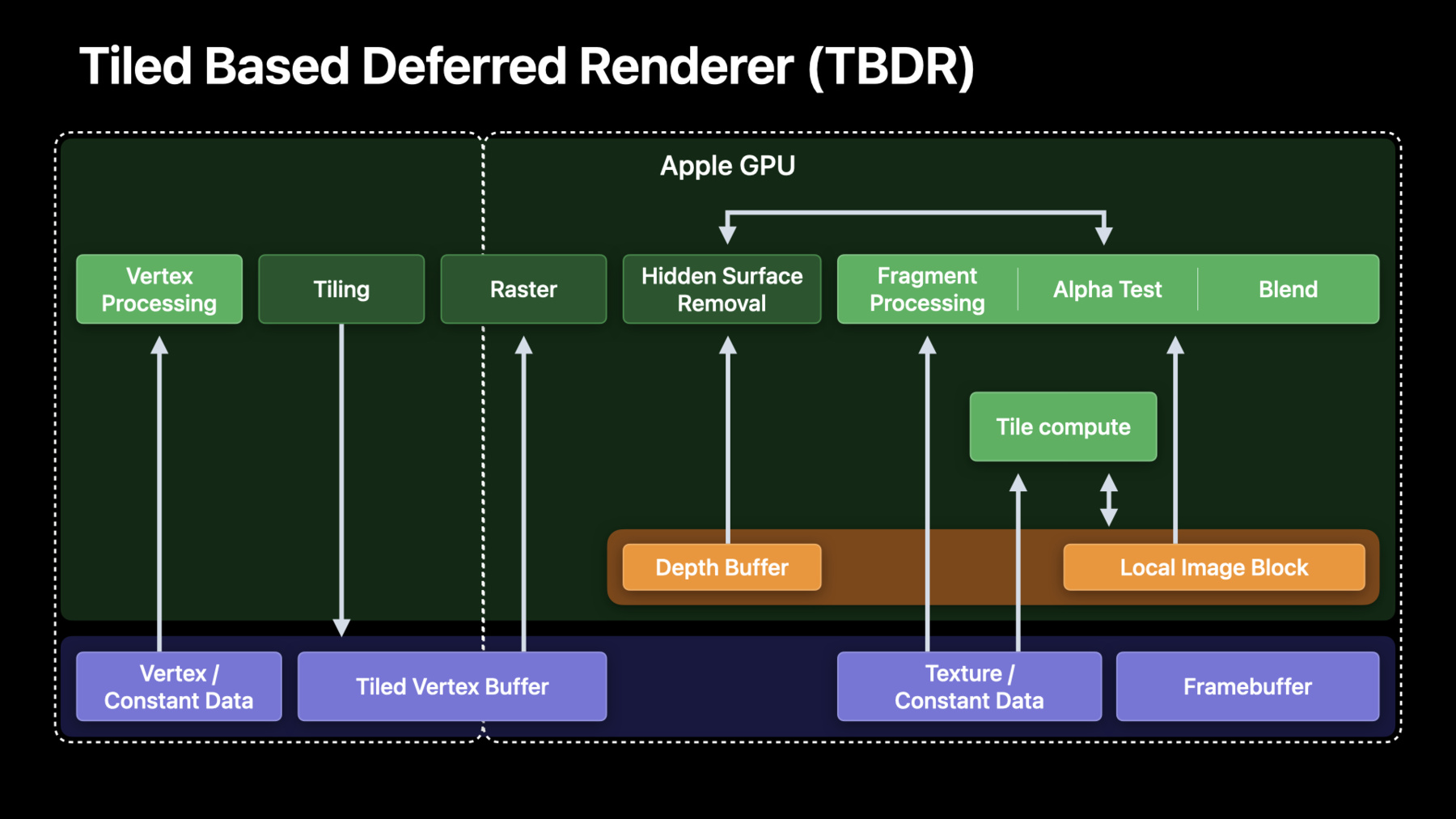
Discover how to optimize your image processing app for Apple silicon. Explore how to take advantage of Metal render command encoders, tile shading, unified memory architecture, and memoryless attachments. We'll show you how to use Apple's unique tile based deferred renderer architecture to create power efficient apps with low memory footprint, and take you through best practices when migrating your compute-based apps from discrete GPUs to Apple silicon.
Recursos
- Debugging the shaders within a draw command or compute dispatch
- Metal Feature Set Tables
- Metal
- Metal Shading Language Specification
Videos relacionados
WWDC20
-
Buscar este video…
-
-
10:53 - Memoryless attachments
let textureDescriptor = MTLTextureDescriptor.texture2DDescriptor(…) let outputTexture = device.makeTexture(descriptor: textureDescriptor) textureDescriptor.storageMode = .memoryless let tempTexture = device.makeTexture(descriptor: textureDescriptor) let renderPassDesc = MTLRenderPassDescriptor() renderPassDesc.colorAttachments[0].texture = outputTexture renderPassDesc.colorAttachments[0].loadAction = .dontCare renderPassDesc.colorAttachments[0].storeAction = .store renderPassDesc.colorAttachments[1].texture = tempTexture renderPassDesc.colorAttachments[1].loadAction = .clear renderPassDesc.colorAttachments[1].storeAction = .dontCare let renderPass = commandBuffer.makeRenderCommandEncoder(descriptor: renderPassDesc) -
12:25 - Uber-shaders impact on registers
fragment float4 processPixel(const constant ParamsStr* cs [[ buffer(0) ]]) { if (cs->inputIsHDR) { // do HDR stuff } else { // do non-HDR stuff } if (cs->tonemapEnabled) { // tone map } } -
13:32 - Function constants for Uber-shaders
constant bool featureAEnabled[[function_constant(0)]]; constant bool featureBEnabled[[function_constant(1)]]; fragment float4 processPixel(...) { if (featureAEnabled) { // do A stuff } else { // do not-A stuff } if (featureBEnabled) { // do B stuff } } -
23:02 - Image processing filter graph
typedef struct
{
    float4 OPTexture        [[ color(0) ]];
    float4 IntermediateTex  [[ color(1) ]];
} FragmentIO;

fragment FragmentIO Unpack(RasterizerData in [[ stage_in ]],
                           texture2d<float, access::sample> srcImageTexture [[texture(0)]])
{
    FragmentIO out;

    //...

    // Run necessary per-pixel operations
    out.OPTexture       = // assign computed value;
    out.IntermediateTex = // assign computed value;
    return out;
}

fragment FragmentIO CSC(RasterizerData in [[ stage_in ]], FragmentIO Input)
{
    FragmentIO out;

    //...

    out.IntermediateTex = // assign computed value;
    return out;
}
-