

-
Discover compilation workflows in Metal
The Metal shading language is a powerful C++ based language that allows apps to render stunning effects while maintaining a flexible shader development pipeline. Discover how to more easily build and extend your render pipelines using Dynamic Libraries and Function Pointers. We'll also show you how to accelerate your shader compilation at runtime with Binary Function Archives, Function Linking, and Function Stitching.
Recursos
- Shader libraries
- Creating a Metal dynamic library
- Metal Feature Set Tables
- Metal
- Metal Shading Language Specification
Videos relacionados
WWDC23
WWDC22
WWDC21
WWDC20
-
Buscar este video…
-
-
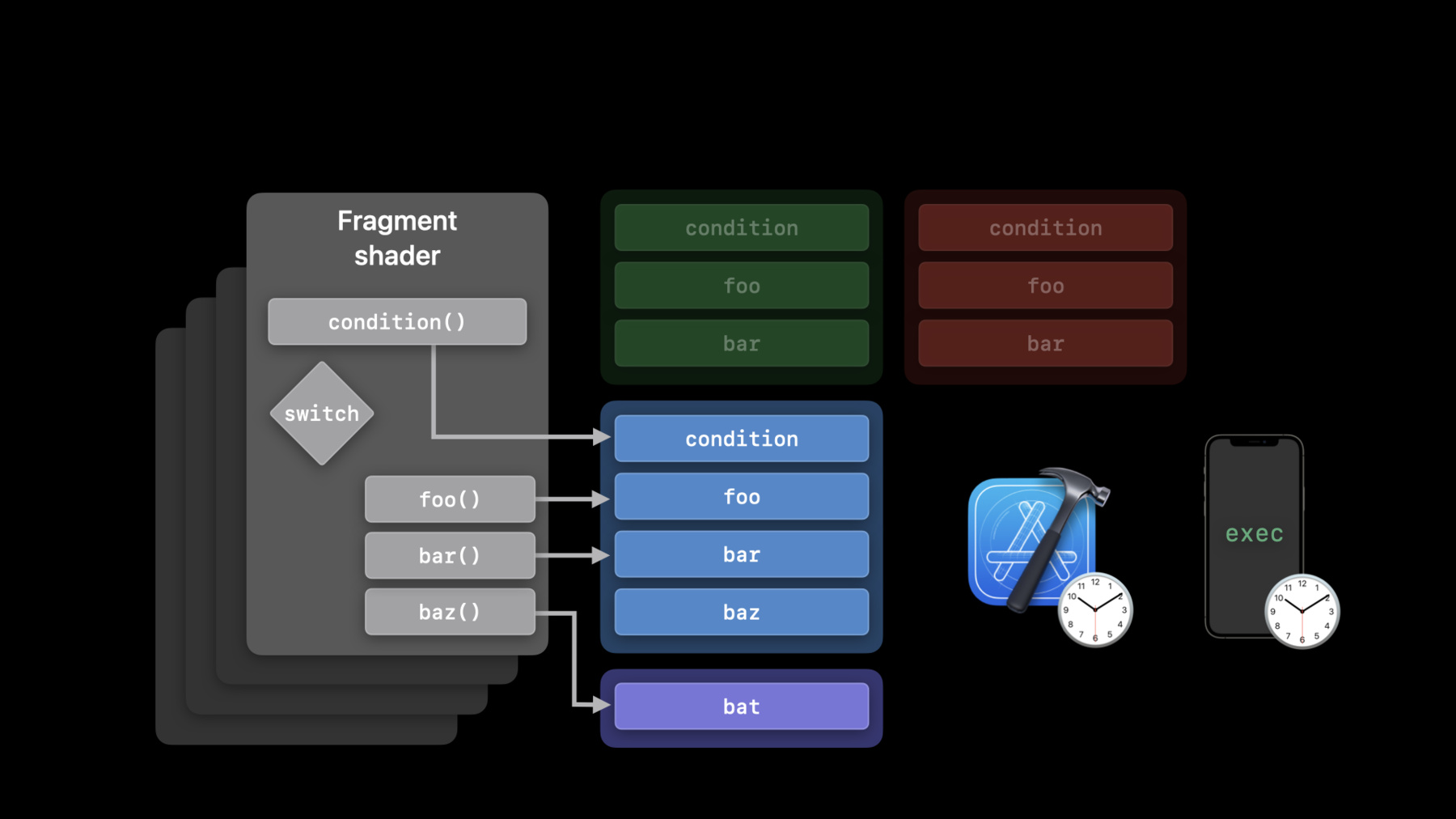
5:38 - Shading language
// Declare external functions extern float4 foo(FragmentInput input); extern float4 bar(FragmentInput input); // Use functions in shader fragment float4 main(FragmentInput input [[stage_in]]) { switch(condition(input)) { case 0: return foo(input); case 1: return bar(input); } } -
9:01 - Declare and instantiate visible functions
// Declare a descriptor and set CompileToBinary options MTLFunctionDescriptor* functionDescriptor = [MTLFunctionDescriptor new]; functionDescriptor.options = MTLFunctionOptionCompileToBinary; // Backend compile the function functionDescriptor.name = @"foo"; id<MTLFunction> foo = [library newFunctionWithDescriptor:functionDescriptor -
9:30 - Configure pipeline descriptor
// Provide a list of functions that the pipeline stage may call // AIR functions renderPipeDesc.fragmentLinkedFunctions.functions = @[foo, bar, baz]; // Binary functions renderPipeDesc.fragmentLinkedFunctions.binaryFunctions = @[foo, bar, baz]; -
10:47 - Create and populate visible function table
// Create visible function table [renderPipeline newVisibleFunctionTableWithDescriptor:stage:]; // Create function handles [renderPipeline functionHandleWithFunction:stage:]; // Insert handles into table [visibleFunctionTable setFunction:atIndex:]; -
11:21 - Encoding and calling function pointers
// Bind visible function table objects to each stage [renderCommandEncoder setFragmentVisibleFunctionTable:atBufferIndex:]; // Usage in shader fragment float4 shaderFunc(FragmentData vo[[stage_in]], visible_function_table<float4(float3)>materials[[buffer(0)]]) { //... return materials[materialSelector](coord); } -
12:20 - Incremental pipeline creation
// Enable incrementally adding binary functions per stage renderPipeDesc.supportAddingFragmentBinaryFunctions = YES; // Create render pipeline functions descriptor MTLRenderPipelineFunctionsDescriptor extraDesc; extraDesc.fragmentAdditionalBinaryFunctions = @[bat]; // Instantiate render pipeline state id<MTLRenderPipelineState> renderPipeline2 = [renderPipeline1 newRenderPipelineStateWithAdditionalBinaryFunctions:extraDesc -
20:30 - Stitching process
[[stitchable]] int FunctionA(device int*, int) {…} [[stitchable]] int FunctionC(int, int) {…} [[stitchable]] int ResultFunction(device int* Input0, int Input1, int Input2) { int N0 = FunctionA(Input0, Input1); int N1 = FunctionA(Input0, Input2); int N2 = FunctionC(N0, N1); return N2; } -
21:32 - Creating the graph
// Create input nodes inputs[0] = [[MTLFunctionStitchingInputNode alloc] initWithArgumentIndex:0]; // Create function nodes n0 = [[MTLFunctionStitchingFunctionNode alloc] initWithName:@"FunctionA" arguments:@[inputs[0], inputs[1]] controlDependencies:@[]]; n1 = [[MTLFunctionStitchingFunctionNode alloc] initWithName:@"FunctionA" arguments:@[inputs[0], inputs[2]] controlDependencies:@[]]; n2 = [[MTLFunctionStitchingFunctionNode alloc] initWithName:@"FunctionC" arguments:@[n0, n1] controlDependencies:@[]]; // Create graph graph = [[MTLFunctionStitchingGraph alloc] initWithFunctionName:@"ResultFunction" nodes:@[n0, n1] outputNode:n2 attributes:@[]]; -
22:18 - Configure stitched library descriptor
// Configure stitched library descriptor

  MTLStitchedLibraryDescriptor* descriptor = [MTLStitchedLibraryDescriptor new];

  descriptor.functions      = @[stitchableFunctions];
  descriptor.functionGraphs = @[graph];

// Create stitched function

  id<MTLLibrary> lib = [device newLibraryWithDescriptor:descriptor
                                                  error:&error];

  id<MTLFunction> stitchedFunction = [lib newFunctionWithName:@"ResultFunction"];
-